Answer Engine Optimization (AEO): How to Increase Visibility in AI Search
A practical guide to Answer Engine Optimization: how AEO differs from SEO and GEO, an 8-step workflow, and how to track Share of Model with SEOSorted.

Your top-ranking page can be losing clicks right now without ever losing its ranking position. That's what happens when Google AI Overviews or a ChatGPT answer resolves the query directly on the results page; the click never happens, even though your rank stayed the same.
Quick answer: Answer Engine Optimization (AEO) is the practice of structuring content so that answer-driven systems featured snippets, voice assistants, Google AI Overviews can extract a single passage as a direct answer. It's distinct from traditional SEO (ranking pages) and from GEO (multi-source synthesis across generative engines like ChatGPT), though the three work together.
A distinction worth making up front: AEO, GEO, AI SEO, and AI Search Optimization get used interchangeably in most industry content, but they describe different mechanics. AEO is about single-passage extraction. GEO is about multi-source synthesis and citation. Conflating them leads to vague advice like "write authoritative content" instead of concrete structural rules.
AEO vs. SEO vs. GEO: The Search Visibility Taxonomy
| Traditional SEO | AEO | GEO | |
|---|---|---|---|
| System objective | Index and rank pages by keyword relevance and link authority | Extract one definitive answer for a conversational query | Synthesize multi-source intelligence into a generated answer |
| Primary surface | Google/Bing organic blue links | Featured snippets, PAA boxes, voice search, AI Overviews | ChatGPT, Perplexity, Gemini, Claude, Copilot |
| Primary value metric | Organic CTR and session volume | Direct answer ownership rate | Share of Model (SoM) and citation frequency |
| Content focus | Comprehensive long-form keyword targeting | Direct answer blocks, Q&A formatting | High fact density, expert quotes, statistics |
| Retrieval mode | Search spiders parsing HTML | Real-time SERP extractors | LLM crawlers (GPTBot, PerplexityBot) and RAG pipelines |
Traditional SEO gets your page indexed and discoverable. AEO structures specific passages within that page so extraction engines can pull them for instant answer boxes. GEO extends this further, building entity authority across the broader web so generative models recognize and cite your brand when synthesizing complex answers.
Three ways a brand can show up in AI output, worth tracking separately: mentions (the brand named without a source link), citations (an explicit footnote or link back to your page), and recommendations (actively suggested as the answer to an unbranded evaluation prompt).
What the Research Actually Shows
Most competitor content in this space either over-relies on schema markup claims or offers vague "write authoritative content" advice without operational metrics. Here's what's actually been empirically tested versus what's industry observation:
| Finding | Impact | Source |
|---|---|---|
| Adding quantitative statistics and figures to prose | +41% lift in position-adjusted word count; +37% in subjective impression | Princeton GEO Benchmark Study (Aggarwal et al., KDD 2024) |
| Adding direct expert quotes and attributed citations | +37% to +41% relative visibility increase | Princeton GEO Benchmark Study |
| Inline citations on lower-ranked pages ("Equalizer Effect") | +115.1% relative visibility lift for pages at SERP Position 5 | Princeton GEO Benchmark Study |
| Keyword stuffing | −10% visibility drop on Perplexity | Princeton GEO Benchmark Study |
| ChatGPT citation position bias | 44.2% of citations originate from the top 30% of page text | Zyppy Multi-Model Citation Study (industry observation) |
| GA4 analytics misclassification | Up to 70.6% of AI referral traffic misclassified as "Direct" | Industry analytics benchmarks (observation) |
| AI Overview impact on organic CTR | 34.5%–61% drop in organic CTR when an AIO appears | Industry SERP tracking (observation) |
The distinction matters: the Princeton study findings are confirmed empirical results from controlled testing. The citation-position and analytics figures are industry observations, not peer-reviewed findings — both are useful, but treat them with appropriately different confidence.
One correction worth making directly: schema markup does not guarantee AI citation. It's genuinely useful for helping traditional search crawlers parse your site, but language models rely primarily on raw text readability, clean semantic headings, and un-rendered textual clarity — not JSON-LD structure. If you're relying on FAQPage schema alone to earn citations, that's not what's actually driving selection.
What Drives AI Citation Selection
Retrieval-augmented generation (RAG) pipelines query web indices, retrieve relevant passages, then feed them to the model to synthesize an answer. Three factors shape what gets retrieved:
- Entity authority — brands with clear Knowledge Graph alignment, consistent Wikidata references, and broad cross-platform mentions get higher baseline trust during retrieval.
- Content quality and extractability — clean H2/H3 hierarchy and high information density reduce parsing friction during passage chunking.
- Search intent alignment — content that resolves the query directly in its leading sections, rather than behind introductory filler, gets prioritized.
An 8-Step AEO Workflow
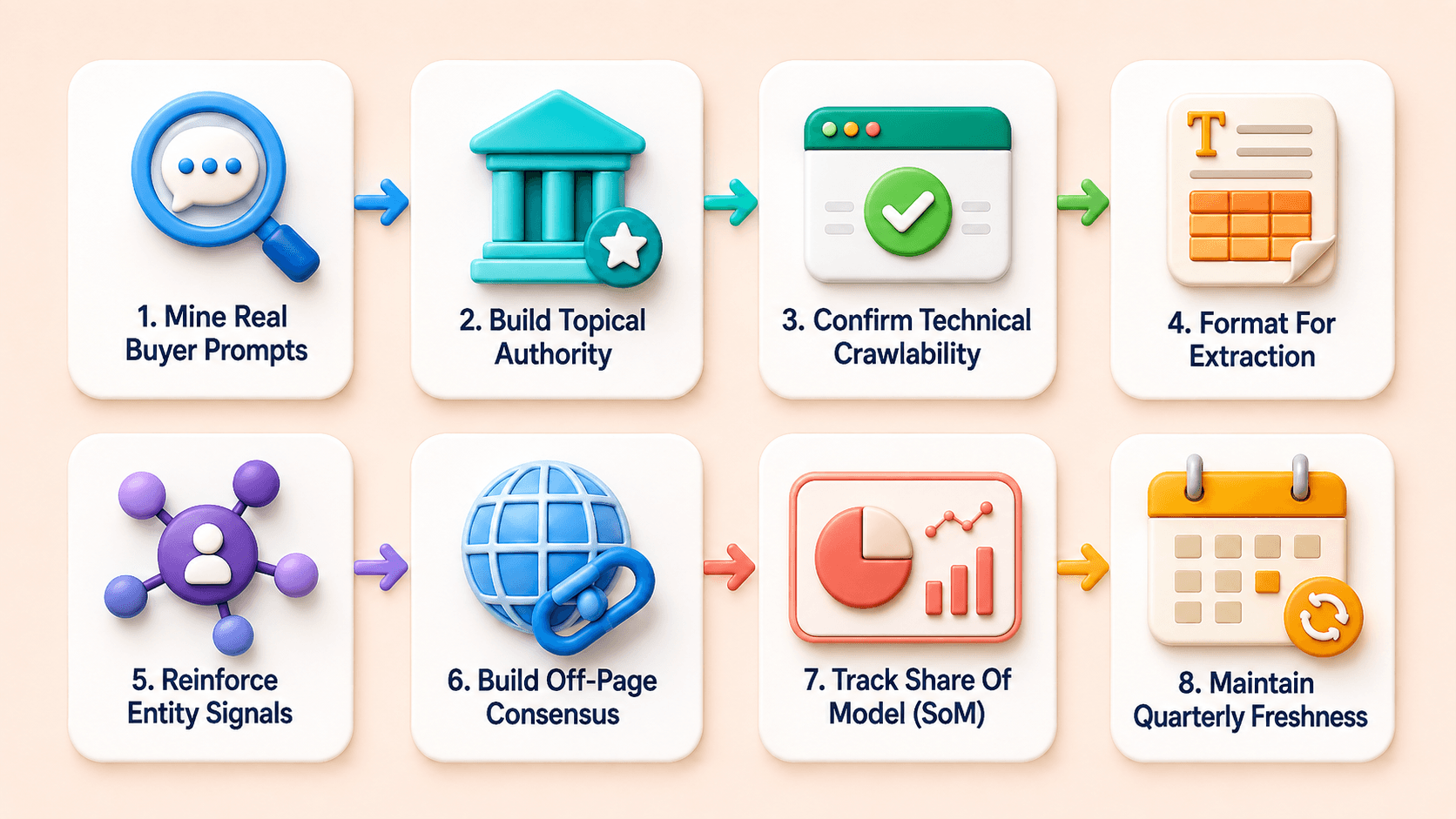
- Mine real buyer prompts. Pull natural-language questions from sales calls, support tickets, and community forums — not just isolated keyword phrases and categorize them by discovery, comparison, evaluation, and implementation stage.
- Build topical authority. Isolated blog posts rarely earn sustained AI citations; construct interconnected content hubs with explicit semantic internal linking so retrieval systems recognize domain-level expertise.
- Confirm technical crawlability. Audit robots.txt to ensure GPTBot, PerplexityBot, ClaudeBot, and Google-Extended aren't blocked, and eliminate JavaScript rendering barriers that hide text from these crawlers.
- Format for extraction. Place direct answers in the top 30% of page text, targeting roughly one verifiable statistic per 100 words, with 40–50 word answer paragraphs directly under H2/H3 question headings.
- Reinforce entity signals. Standardize Organization and Author JSON-LD schema with a sameAs array linking to Wikidata, Crunchbase, and verified social profiles.
- Build off-page consensus. Secure mentions across Reddit, G2, trade press, and analyst coverage — this is where a meaningful share of brand validation for AI systems actually happens, not solely on your own site.
- Track Share of Model (SoM). Run standardized prompt sets across ChatGPT, Perplexity, Gemini, and AI Overviews on a recurring schedule, and set up GA4 segmentation to isolate misattributed AI referral traffic.
- Maintain quarterly freshness. AI systems weight recency for fast-evolving topics; refresh statistics and publication dates regularly to prevent citation decay to newer competitor content.
Common Mistakes
- Keyword stuffing — degrades readability and can reduce citation probability by up to 10% on platforms like Perplexity.
- Relying solely on schema markup — FAQPage schema alone doesn't guarantee citations without genuine structural extractability.
- Burying the answer — placing definitions deep within long introductory sections where models are less likely to extract from.
- Operating in a first-party vacuum — optimizing only owned content while ignoring the off-page mentions and reviews AI systems actually weigh for trust.
Fixing the Two Biggest Structural Problems
Strong Google rankings, low AI Overview visibility. Usually means the page has domain authority but lacks direct-answer formatting and fact density, so Google's RAG pipeline bypasses it.
Fix: insert a 40-50 word summary directly beneath the H1, convert narrative into structured Markdown tables, and make sure H2 headers reflect actual conversational questions followed by immediate answers.
Hidden AI referral traffic in GA4. Native AI apps often strip HTTP referral headers, so up to 70.6% of that traffic can land in "Direct" reports instead of being attributed correctly. Fix: deploy GA4 segmentation to isolate unreferred sessions landing on deep content URLs, and pair that with dedicated Share of Model tracking rather than relying on GA4 alone.
AEO by Business Model
B2B SaaS losing visibility on unbranded evaluation prompts ("top project management tools for remote teams") benefits from a dedicated comparison hub with structured tables, proprietary usage data, attributed customer quotes, and expanded presence on G2, Capterra, and relevant Reddit discussions.
E-commerce losing traffic to zero-click AI Overviews on buyer-guide queries should replace marketing narrative with structured technical spec tables, comprehensive Product JSON-LD, and concise FAQ blocks addressing sizing and assembly questions directly beneath product copy.
Local service businesses targeting conversational voice queries ("most reliable HVAC repair near me") need standardized LocalBusiness schema with service areas and licensing, plus explicit Q&A headings followed by 40-word answer summaries addressing region-specific questions.
Streamlining AI Visibility with SEOSorted
When the transition is from static keyword lists to full conversational buyer prompts, this is where SEOSorted's keyword research module fits in, identifying conversational question syntax and PAA expansions across both traditional SERPs and generative engines, so mapping a target prompt set doesn't mean manually mining transcripts one at a time.
For the formatting rules covered above, top-30% answer placement, fact-density targets SEOSorted's content optimization suite audits draft or published copy for structural extractability, flags buried answers, and measures numerical fact density per 100 words with concrete recommendations rather than generic "add more authority" advice.
And because manually testing AI citations across four different platforms is genuinely time-consuming and prone to sampling bias, SEOSorted's AI Search Insights dashboard automates visibility benchmarking across ChatGPT, Perplexity, Gemini, and AI Overviews — tracking citation frequency and Share of Model against competitors over time.
Common questions
AEO is the practice of structuring digital content so search engines, voice assistants, and AI platforms can extract direct answers to user questions distinct from traditional SEO, which focuses on driving clicks to a ranked page.
Traditional SEO improves page rankings to generate organic clicks. AEO optimizes specific passages to be extracted as direct answers, satisfying the query immediately on the results interface without requiring a click.
AEO focuses on single-passage extraction for answer blocks and voice queries. Generative Engine Optimization (GEO) focuses on multi-source synthesis, optimizing content so models like ChatGPT and Perplexity cite your brand when building comprehensive responses.
No. Schema helps traditional crawlers parse your site, but empirical research shows it has minimal direct impact on LLM citations, which prioritize raw text readability, clean headings, and fact density over structured data alone.
Primarily through Share of Model (SoM), the percentage of AI-generated responses mentioning or citing your brand relative to competitors across a target prompt set, supported by citation frequency and AI-referred traffic conversions.
When AI Overviews or other zero-click features appear above your organic listing, users get resolution directly on the results page, reducing click volume even though your ranking position hasn't changed.
Q&A sections, concise 40-word definition blocks, structured Markdown comparison tables, bulleted process lists, and statistical references with direct answers placed in the top 30% of page text.
Yes, the Princeton GEO study's "Equalizer Effect" found that adding citations, statistics, and expert quotes lifted visibility by up to 115% for lower-ranked pages (Position 5), meaning domain authority alone doesn't determine AI citation outcomes.
Other Features

How to Rank on ChatGPT: A Practical Guide to ChatGPT Search Visibility
A practical guide to ChatGPT Search visibility: what's confirmed, what's inference, and an 8-step framework to earn citations, not chase a fake #1 rank.

How to Rank on Claude: A Practical Guide to Claude Search Visibility
A practical guide to Claude's web-retrieval behavior: what's documented, what's inference, and an 8-step framework to earn citations, not chase a fake rank.

How to Appear on Gemini: A Practical Guide to AI Search Visibility
A practical guide to Gemini's web-retrieval behavior, distinct from Google AI Overviews, with a framework to track citation visibility over time.

Start building your content library in under 8 minutes.
Your competitors are publishing every week. Every week you don't is a week of organic traffic going to them.
No Credit Card Required.