How to Rank on Claude: A Practical Guide to Claude Search Visibility
A practical guide to Claude's web-retrieval behavior: what's documented, what's inference, and an 8-step framework to earn citations, not chase a fake rank.

Ranking #1 on Google doesn't guarantee Claude will ever mention you. There's no permanent #1 position to chase on Claude either; it generates responses per prompt from retrieved web content, not a static ranked list.
Quick answer: There's no fixed Claude ranking position. Claude can search the live web and cite sources in its answers. The practical goal is citation and recommendation visibility across the prompts relevant to your business, not a rank. Traditional SEO helps somewhat, since it supports general discoverability, but it doesn't guarantee Claude visibility on its own.
A quick definition, since "appear on Claude" gets used loosely:
- Mention (named, no link),
- Citation (linked as a source),
- Recommendation (actively suggested).
Citation accuracy whether the cited page genuinely supports what Claude says matters too, and is covered in the measurement section below.
This guide covers Claude's web-retrieval behavior, not what the underlying model already "knows" from training data; separate systems, separate mechanics.
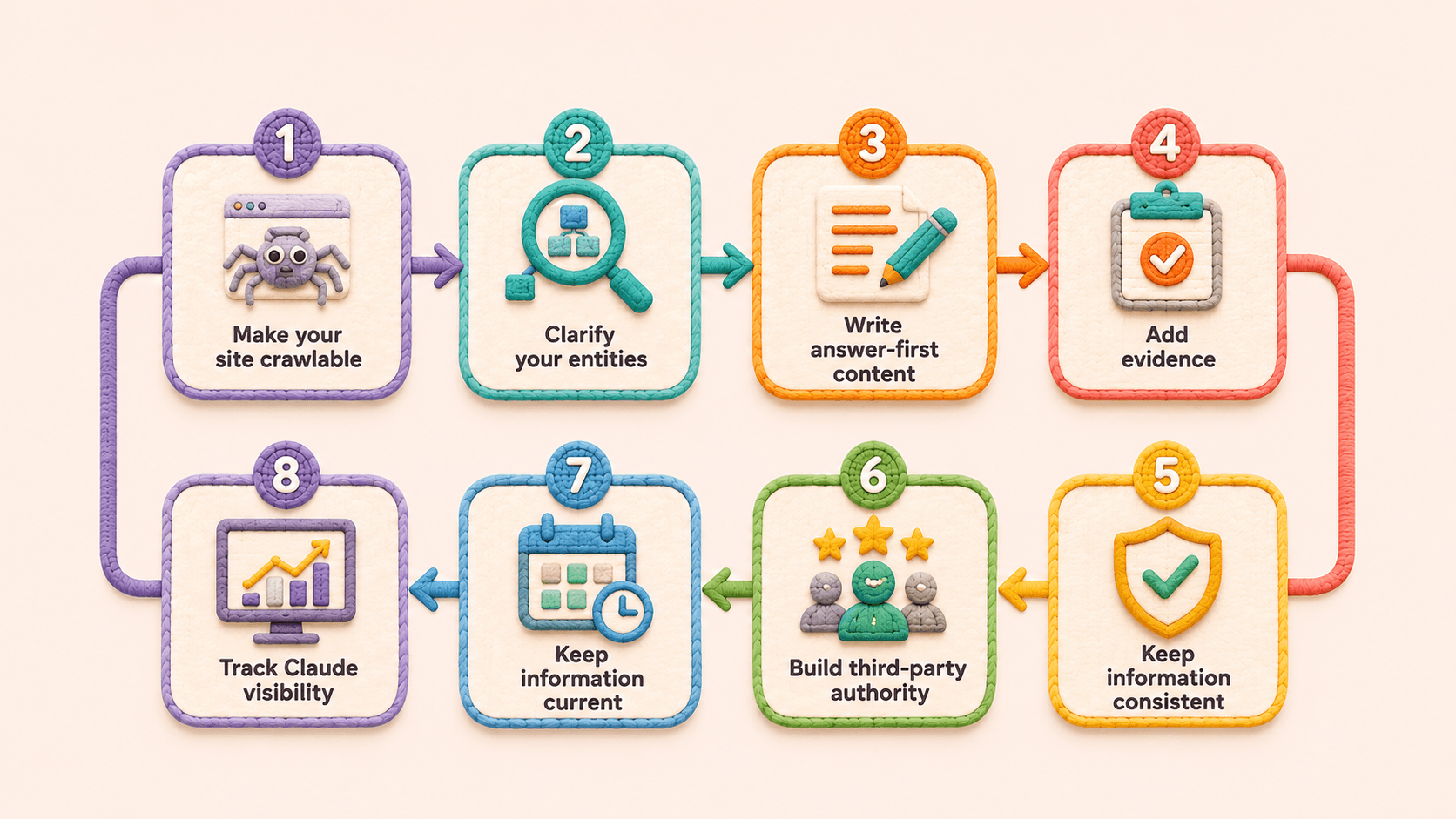
The 8-step framework:
How Claude's Web Retrieval Works
Anthropic's own description is intentionally general: when Claude uses web search, it searches the live web, processes information from multiple sources, and synthesizes an answer with citations. Anthropic hasn't published the exact source-selection formula behind this; treat any more specific technical claim, including from this guide, as inference rather than documented fact.
Content that directly and factually answers a question tends to perform better in synthesized responses than marketing-heavy narrative, consistent with how retrieval systems generally behave, though not a confirmed Claude-specific rule.
8 Ways to Improve Your Claude Visibility
1. Make your site crawlable. Anthropic documents distinct user-agents (Anthropic's crawler documentation verifies current names and behavior directly, since this can shift):
| Crawler | Documented Purpose | Effect of Blocking |
|---|---|---|
| ClaudeBot | Collects data for model training | Affects training use, not necessarily live retrieval |
| Claude-SearchBot | Navigates and analyzes online content to improve Claude search results | Can reduce eligibility for citation in search-enabled answers |
| Claude-User | Fetches URLs users share directly | Can block analysis of shared links |
Each of the three agents can be controlled independently in robots.txt using its exact documented user-agent string. Check logs for HTTP 200 responses from these agents rather than 403/429s; a WAF can rate-limit crawler traffic at the edge, invisible in your own application logs. Verify requests against Anthropic's published documentation rather than user-agent strings alone, since those can be spoofed.
2. Clarify your entities. Use Organization, Product, or SoftwareApplication schema where genuinely applicable, kept exactly consistent with visible content. Not a confirmed citation factor on its own, but inconsistent information (different pricing on your site vs. a review platform) can make entity information harder for any system to interpret.
3. Write answer-first content.
Before: "Search engine optimization has evolved significantly over the past decade..."
After: "ProjectTool provides enterprise task management with SOC-2 compliance and native Slack/Teams integration."
The second gives a retrieval system a self-contained claim to extract.
4. Add evidence. Original statistics, case studies, or named expert commentary- genuinely available ones, not generic claims.
5. Keep information consistent. When pricing or features change, update your site and third-party listings together. Consistency matters more here than any specific schema type.
6. Build third-party authority. Genuine presence on relevant review platforms and communities reflecting real usage, not engineered mentions.
7. Keep information current. Update facts when they actually change; there's no evidence for a fixed refresh cadence.
8. Track Claude visibility. Covered below: one response in one session isn't proof of visibility either way.
Claude vs. ChatGPT: What Changes?
The broader AI-search principles overlap across platforms, but the implementation details differ:
| Dimension | Traditional SEO | Claude Visibility |
|---|---|---|
| Primary unit | Keyword | Prompt |
| Main outcome | Ranking position | Citation/recommendation |
| Measurement | SERP position | Citation inclusion rate |
| Variability | Query/rank changes | Prompt, session, and source can all change |
Practically: crawler names and directives differ (Claude-SearchBot vs. OAI-SearchBot), citation terminology and formatting differ slightly between the two assistants, and measurement should be run as a separate prompt panel per platform rather than assuming one tracking set covers both. Don't assume identical ranking mechanics just because both are retrieval-and-synthesis systems; verify platform-specific documentation separately.
What the Research Actually Shows
A KDD 2024 study by Aggarwal et al., "GEO: Generative Engine Optimization," tested visibility tactics across generative search engines broadly, not Claude specifically. Reported effects in the study's own experiments:
| Tactic | Reported Effect in the GEO Study |
|---|---|
| Adding cited statistics/data | Roughly 30-41% visibility increase |
| Attributed expert quotes | Roughly 30-41% visibility increase |
| Precise technical terminology | Roughly 18-28% visibility increase |
| Keyword stuffing/repetition | Negative effect |
These percentages are from the study's tested generative engines and shouldn't be read as Claude-specific citation increases; treat them as directional evidence worth testing, not a guaranteed multiplier. The strongest evidence hierarchy here, in order: Anthropic's own documentation, direct Claude-specific testing, this broader research, then general industry observation.
An Original Claude Visibility Research Methodology
Rather than borrowing generic AI-search statistics, the most useful differentiator is genuine, disclosed first-party testing. Here's the methodology such a study would follow, presented as a framework, not as findings, since no percentage should be published before real data exists:
- Cross-brand testing — a fixed set of prompts (e.g., 250-500) run across a set of brands (e.g., 50-100), recording mentions, citations, recommendations, and citation accuracy.
- Prompt-intent breakdown — informational, commercial, comparison, problem-solving, transactional, and brand prompts, to see where visibility concentrates.
- Cited page and source type — categorizing which formats (blog, product page, comparison, review site, forum, documentation) get cited most.
- Cited vs. non-cited comparison — checking for direct-answer openings, original data, expert quotes, freshness, and structure across similar pages.
- Competitor citation-gap workflow — run target prompts, export cited domains, identify sources that mention competitors but not your brand, and prioritize legitimate inclusion opportunities on those specific domains.
- Prompt volatility check — running identical prompts repeatedly to record whether cited sources, competitors, or citation order changed- direct evidence for why "ranking" isn't the right mental model here.
Illustrative Example
A project management tool ranks #2 on Google for "enterprise task management software" but doesn't surface in Claude's responses, while competitors do. Possible contributing factors: marketing-heavy copy without direct factual claims, and thinner third-party presence than competitors' active review and forum discussions.
Reasonable next steps: rewrite the product page opening as a direct, factual statement; add a comparison table; build genuine review-platform presence; publish a case study with sourced metrics. This is illustrative; it doesn't prove these specific actions produce a citation, since visibility depends on many factors including competition and query phrasing. Track prompts before and after to see whether anything actually changed.
Measuring Claude Visibility
Track citation frequency instead of rank position. Build a fixed panel of 20-30 prompts spanning your core intent categories, and run it consistently; monthly is a reasonable cadence. For each prompt, record:
- Brand mention — is your brand named at all?
- Citation presence — is it cited with a source link?
- Citation accuracy — does the cited page genuinely support the claim Claude is making?
- Source type — brand site, review platform, forum, or documentation?
- Citation position — where observable, does it appear early or late in the response?
- Competitors cited — who else shows up in the same answer?
Track recommendation separately from citation; being cited as a source isn't the same as being actively recommended, and conflating the two will overstate your actual visibility.
Citation Inclusion Rate = prompts where cited ÷ total tracked prompts × 100.
Competitive Citation Share = your citations ÷ total citations across tracked competitors × 100
Quick Audit Checklist
- Claude-SearchBot receives HTTP 200 responses in logs
- robots.txt doesn't block Claude-SearchBot
- Top pages open with direct, factual answers
- Schema (where applicable) matches visible content exactly
- Pricing and features are consistent across your site and third-party listings
- A fixed 20-30 prompt panel is tracked on a consistent schedule, including source type and citation accuracy
A 5-Step Starting Plan
- Confirm Claude-SearchBot isn't blocked in robots.txt or your WAF.
- Build a fixed panel of 20-30 prompts across your core categories.
- Rewrite your top pages to open with direct, sourced answers.
- Run a competitor citation-gap check to find domains that cover rivals but not you.
- Re-run your prompt panel monthly, tracking citation accuracy and source type over time.
The goal isn't a Claude ranking position; it's being a clear, factually consistent, corroborated source for the questions your buyers are asking.
Common questions
No, responses are generated per prompt with no fixed positions. Optimize for citation inclusion rate instead.
ClaudeBot relates to training-data collection; Claude-SearchBot analyzes content to improve live search results. Confirm current definitions directly against Anthropic's documentation, since scope can change.
Anthropic hasn't confirmed a specific search backend; avoid unsupported claims about the underlying infrastructure.
It can help systems interpret entities consistently, but there's no established evidence that it directly increases the likelihood of citations.
Not confirmed directly. They may support broader discoverability and third-party corroboration, but treat this as an observed pattern, not a documented ranking factor.
Often a combination of thinner third-party presence, less direct factual content, or gaps in specific source coverage; a competitor citation-gap check against the same prompts is the most concrete way to investigate.
Other Features

How to Rank on ChatGPT: A Practical Guide to ChatGPT Search Visibility
A practical guide to ChatGPT Search visibility: what's confirmed, what's inference, and an 8-step framework to earn citations, not chase a fake #1 rank.

How to Appear on Gemini: A Practical Guide to AI Search Visibility
A practical guide to Gemini's web-retrieval behavior, distinct from Google AI Overviews, with a framework to track citation visibility over time.

How to Appear on Perplexity: A Practical Guide to AI Search Visibility
A practical guide to Perplexity's citation behavior — what's documented, what's observed, and how to track visibility across a tracked prompt panel.

Start building your content library in under 8 minutes.
Your competitors are publishing every week. Every week you don't is a week of organic traffic going to them.
No Credit Card Required.