AI Blog Writer: How to Create High-Ranking, SEO-Friendly Blog Posts
Yes, once a draft is reviewed and approved, it can be published directly to your connected CMS along with generated metadata and schema.

Most searches for "AI blog writer" aren't really about generating paragraphs; general models already do that. They're about closing the gap between raw AI text and a publish-ready, search-optimized asset. That gap is where most tools, and most workflows, fall short.
Quick answer: a dedicated AI blog writer differs from a general chatbot by anchoring output to live SERP data, search intent, and semantic coverage before a human ever edits it, and the strongest results still come from pairing that speed with a real editorial review step, not skipping it.
What Is an AI Blog Writer?
An AI blog writer is a tool built specifically to produce search-optimized, structured articles as distinct from a general-purpose chatbot that generates prose from static training patterns. The meaningful differences: parsing live top-ranking pages instead of relying only on training data, classifying search intent so the output actually matches what a query expects, identifying the semantic terms needed for topical coverage, building heading structures based on how competitors organize the topic, and applying a consistent brand voice instead of generic corporate phrasing.
Why This Matters for Content Teams
Generative AI has compressed research and drafting time dramatically, but publishing volume without the right structure doesn't translate into rankings. A technically fluent, well-written draft can still fail to rank if it misses search intent or lacks genuine depth, because ranking depends on matching what a query actually needs, not just producing readable sentences. Tools that skip live SERP grounding tend to produce this exact failure mode: fluent, ungrounded, unranked.
What Makes a Good AI-Assisted Blog Post
- Answers the actual search intent — informational, commercial, or transactional rather than generic prose around a keyword.
- Covers the semantic ground competitors cover— not just the primary keyword, but the related terms and subtopics that signal real depth.
- Opens with a direct answer, not a scene-setting introduction.
- Includes original, verifiable evidence — specific data, named sources, real examples instead of vague claims.
- Reflects genuine brand voice, not templated corporate tone.
Common Problems and Why They Happen
Generic, repetitive phrasing. Models default to average language patterns unless constrained by a real brief and brand voice profile; unconstrained prompts are the usual cause.
High editing overhead. Teams often report that fixing an AI draft takes longer than writing from scratch. This is almost always because the draft was treated as a finished product rather than a structural starting point; fact-checking and voice work still need to happen.
Search intent mismatch. A 2,000-word article can still fail to rank if it doesn't match what search engines currently reward for that specific query. This happens when no one checked the live SERP before drafting.
Fear of ranking penalties. Many teams hesitate to use AI tools at all, worried about search penalties. Google's own guidance is direct here: ranking systems evaluate quality, accuracy, and helpfulness, not production method. What actually violates guidelines is thin, unverified, mass-produced content created primarily to manipulate rankings, regardless of who or what wrote it.
How to Do This Well: A 5-Step Workflow
- Research and intent discovery — identify the target query, check current top-ranking pages, confirm the intent (informational, commercial, transactional).
- Content architecture — build an outline with descriptive H2/H3s matched to how people actually phrase the question, not generic labels.
- Controlled drafting — generate section by section against that outline and a defined brand-voice profile, not a single unstructured prompt.
- Editorial review and E-E-A-T injection — a human verifies every claim, removes robotic transitions, adds first-hand perspective, and confirms sources are real and current. This step can't be automated away.
- Optimization and publishing — internal links, metadata, and schema, then a final visual check before it goes live.
Why Doing This Manually (or With a Generic Tool) Gets Hard
Without live SERP grounding, every article starts from a blank guess about what "good" looks like for that query; research that a dedicated tool can do in seconds takes real analyst time by hand. Without intent classification, teams risk writing the wrong format entirely (a listicle where a comparison table would rank, for instance). And without a structured brief and brand-voice profile baked in from the start, editorial review balloons, because the AI draft needs restructuring rather than just polishing.
This is exactly the operational gap a dedicated AI blog writer is built to close, not by removing the human step, but by making the input to that step far stronger.
How SEOSorted's AI Blog Writer Works
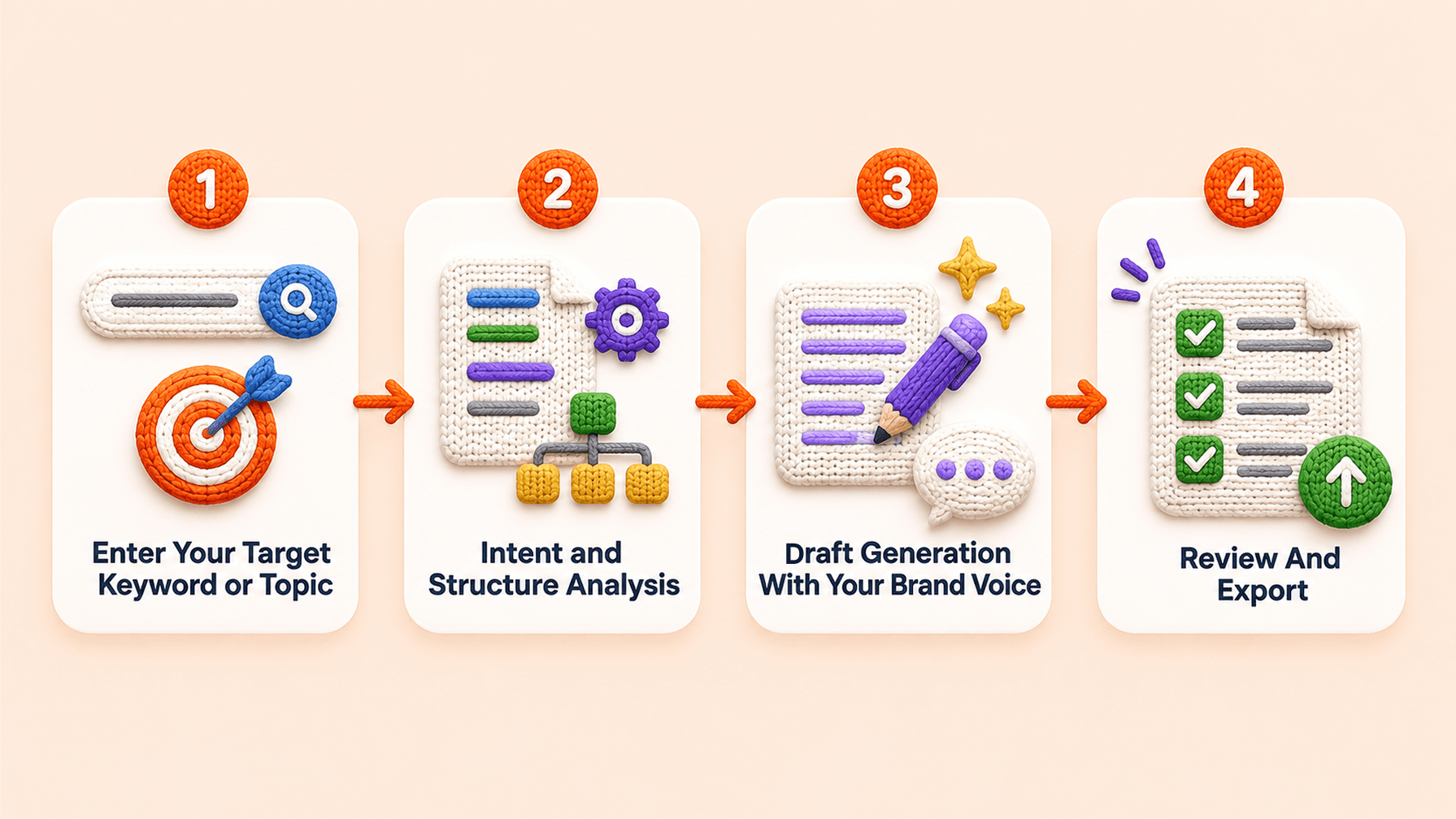
What it does:
SEOSorted's AI Blog Writer generates long-form, SEO-structured drafts anchored to live search data rather than a generic chatbot response, so the starting draft already reflects real search intent, competitive structure, and semantic coverage before an editor ever touches it.
How it works:
- Enter your target keyword or topic. SEOSorted parses the current top-ranking pages for that query in real time.
- Intent and structure analysis. The system classifies search intent and builds an outline with descriptive headings matched to competitor structure and semantic gaps.
- Draft generation with your brand voice. Content is generated section by section against that outline and your saved brand-voice profile, not a single unconstrained prompt.
- Review and export. The draft, along with suggested metadata, internal links, and schema, is staged for editorial review before publishing.
Key capabilities:
- Real-time SERP parsing and search-intent classification
- Semantic entity coverage so drafts match topical depth, not just keyword placement
- Custom brand-voice profiles to avoid generic, templated phrasing
- Automated internal link suggestions from your existing sitemap
- Metadata and JSON-LD schema generation alongside the draft
- Direct CMS publishing once a draft is reviewed and approved
Who it's for:
- SaaS content teams needing consistent output without hiring additional writers for every topic
- SEO and digital agencies managing multiple client blogs with different brand voices and niches
- Small business owners who need to maintain a publishing cadence without dedicated in-house marketing staff
- Publishers and affiliates covering long-tail queries across large content libraries
Example Workflow
A boutique consultancy wants two long-form articles a week, but the founder currently spends most of a workday writing each one by hand. Using SEOSorted, the founder enters a target keyword; the tool returns a SERP-informed outline and a first draft within minutes, already structured around the query's actual intent and semantic gaps. The founder then spends real, meaningful time, not zero, adding two client examples, verifying every statistic, and adjusting tone to match their voice. This is illustrative of the workflow, not a guaranteed time savings; actual results depend on topic complexity and how much original material is added.
Best Practices
- Never publish a first draft unedited — human review for facts and voice is what protects quality and rankings.
- Anchor every draft to live search data, not static training patterns alone.
- Structure for AI answer engines too — direct answers, clear entity definitions, and sourced claims help with ChatGPT Search and Perplexity citations as well as traditional rankings.
- Match format to intent — a comparison table for a "vs" query, a direct answer block for an informational one.
Common questions
No, Google's guidance confirms ranking systems evaluate quality and helpfulness, not production method. Mass-produced, unverified content created to manipulate rankings violates policy regardless of whether AI or a human wrote it.
Yes, when AI drafting speed is paired with real search-intent research and genuine editorial review, not on AI alone. There's no fixed timeline; results vary by topic and competition.
For SEO-specific work, yes, generally live SERP parsing and intent classification give a head start that a static chatbot doesn't have. Either way, human review remains essential.
It analyzes your existing sitemap and suggests contextually relevant internal links as part of the draft, rather than requiring manual link mapping after the fact.
Yes, once a draft is reviewed and approved, it can be published directly to your connected CMS along with generated metadata and schema.
Other Features

How to Rank on ChatGPT: A Practical Guide to ChatGPT Search Visibility
A practical guide to ChatGPT Search visibility: what's confirmed, what's inference, and an 8-step framework to earn citations, not chase a fake #1 rank.

How to Rank on Claude: A Practical Guide to Claude Search Visibility
A practical guide to Claude's web-retrieval behavior: what's documented, what's inference, and an 8-step framework to earn citations, not chase a fake rank.

How to Appear on Gemini: A Practical Guide to AI Search Visibility
A practical guide to Gemini's web-retrieval behavior, distinct from Google AI Overviews, with a framework to track citation visibility over time.

Start building your content library in under 8 minutes.
Your competitors are publishing every week. Every week you don't is a week of organic traffic going to them.
No Credit Card Required.