How to Appear in Google AI Overviews: A Guide to AI Search Visibility
A practical guide to Google AI Overviews: what's documented, what's third-party research, and a 5-step plan to track citation presence over time.

Ranking #1 on Google doesn't guarantee a place in AI Overviews. That's not necessarily bad news; some third-party research suggests AI-cited pages aren't limited to the organic top 10, which points to real opportunity even for pages that don't hold the top spot. Treat the specific numbers behind that claim as directional rather than settled, since methodology and timeframes vary study to study.
A distinction worth making up front: AI Overviews is a feature inside Google Search itself, distinct from standalone Gemini or other AI assistants. This guide is specifically about visibility within Search's AI-generated summaries.
Google documents the general shape of how AI Overviews work (Google's AI Overviews documentation) but hasn't published the specific selection algorithm. What follows separates Google's own documentation, third-party research (from firms like BrightEdge and Ahrefs, cited where referenced), and industry observation, each labeled, since the exact weight of any individual factor isn't confirmed.
Why "Rank #1" Isn't The Right Mental Model
AI Overviews synthesize a summary that can draw on multiple sources rather than surfacing a single ranked link, though there is certainly some source-selection and ranking logic operating behind the scenes that Google hasn't fully disclosed. Per Google's documentation, AI Overviews retrieve information from Google's Search index and generate a response grounded in that content. Crawlability and indexability are clearly important prerequisites here, the same way they are for standard Search results, though Google hasn't published a complete, separate set of technical eligibility requirements specific to AI Overviews.
Appearing in an Overview isn't one single outcome. For tracking purposes, it's useful to separate: mentioned (no link), cited (linked source), primary source (featured prominently), and secondary source (supporting information). Note these are practical tracking categories for measurement purposes, not necessarily Google's own official classification system.
Through observation, not official documentation, Google's systems appear to address several related angles of a topic within one synthesized answer. A query like "best project management software for remote teams" seems to draw on core functionality, distributed-team requirements, comparisons, and pricing simultaneously. This suggests covering the cluster of related questions around a topic is more useful than targeting one exact keyword phrase.
What the Research Actually Shows
- Organic overlap may be shifting. Some search analytics firms have reported that the share of AI-cited pages also ranking in the organic top 10 has changed since AI Overviews expanded, but studies vary in dataset, vertical, and time period, so treat this as an observed trend worth testing on your own queries rather than a fixed statistic.
- Word count alone doesn't appear to predict citation. Ahrefs has published analysis finding minimal correlation between total page length and citation probability; check Ahrefs' current published research directly for the specific dataset and methodology before citing an exact figure. Clarity and structure appear to matter more than volume.
- Freshness matters unevenly. Recently updated content appears to show up more often in Overviews for topics where facts change quickly- pricing, news, current events. For genuinely evergreen topics, frequent updates may not carry the same benefit.
- E-E-A-T is an inference, not a confirmed factor. Google's Search Quality Rater Guidelines emphasize Experience, Expertise, Authoritativeness, and Trustworthiness as part of its broader search-quality framework. Research and observation suggest AI systems tend to favor credible sources, but Google hasn't officially confirmed E-E-A-T as a direct, specific AI Overview selection factor.
Google doesn't publish its AI Overview selection algorithm. Treat all of the above as informed hypotheses to test against your own content and query set, not confirmed ranking rules.
Five Optimization Areas
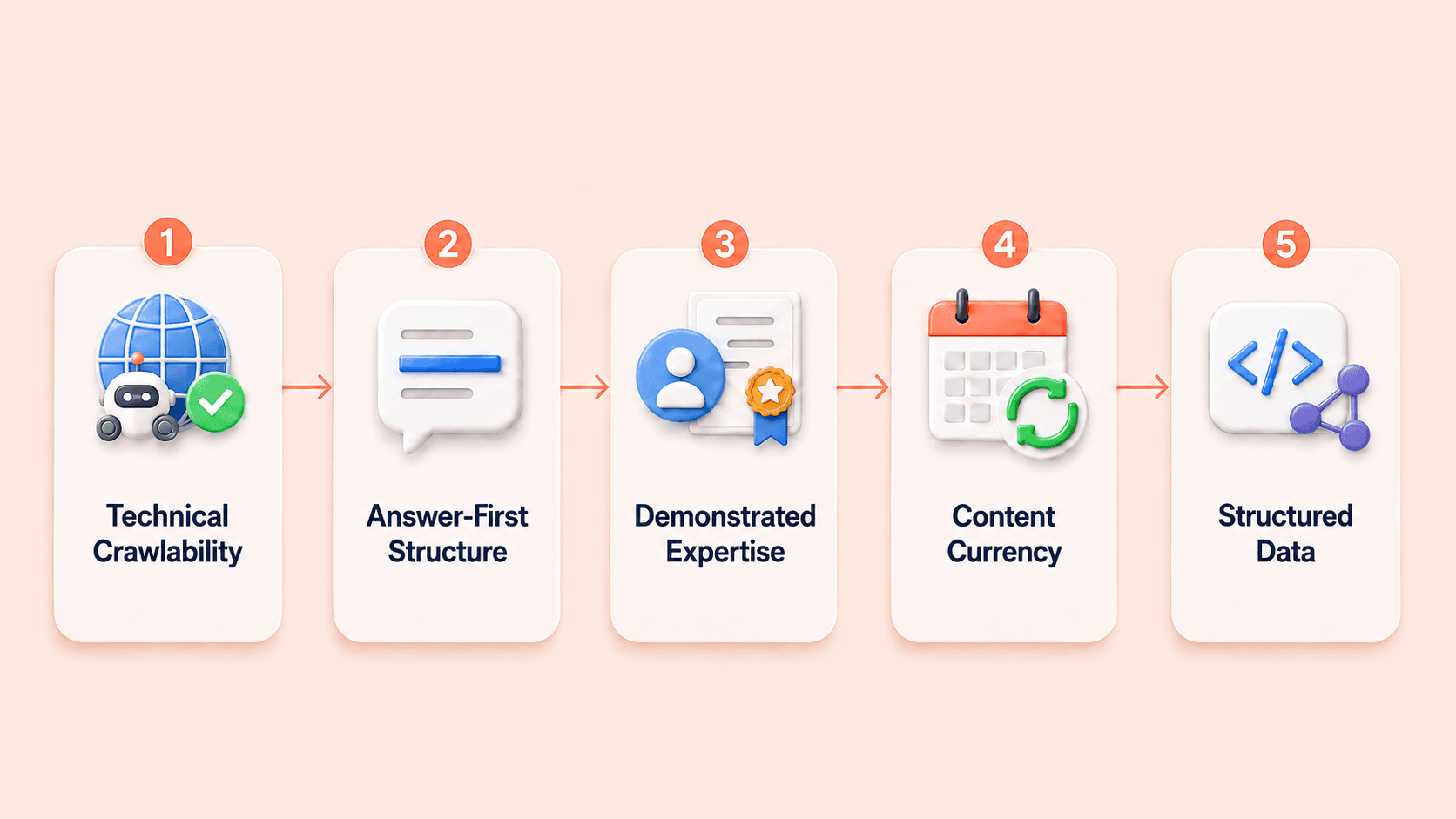
- Technical crawlability — confirm Googlebot can access your content, pages aren't accidentally noindexed, JavaScript-heavy content renders properly, and your server responds promptly. This remains foundational; AI Overview visibility doesn't replace the need for solid technical SEO.
- Answer-first structure — open sections with a direct, self-contained answer before expanding into supporting detail.
- Demonstrated expertise — clear author credentials, original research or case data, and genuine third-party mentions, consistent with Google's general quality guidance even where its specific role in AI Overview selection isn't confirmed.
- Content currency — update high-value pages where the underlying facts change often (pricing, features, industry data); less critical for genuinely evergreen material.
- Structured data — Article and FAQPage JSON-LD schema are not required for AI Overview visibility and are not confirmed as direct AI Overview selection factors. They can help Google parse content accurately and may support eligibility for other search features, but don't assume a direct citation benefit without a specific Google source confirming it.
A Practical Workflow
- Prioritize target queries — focus where business value is high, you already have some ranking or traffic, AI Overviews commonly appear, and competitors aren't dominating the citation.
- Map related subtopics — pull 3-5 related questions from "People Also Ask," autocomplete, Search Console queries, and real customer questions.
- Restructure for clarity — rewrite key pages with direct 2-3 sentence answers at the top of each section, scannable tables or lists, and a clear heading hierarchy.
- Strengthen credibility — add verified author bylines, links to real credentials, citations to primary data, and genuine third-party coverage.
- Implement schema where relevant — add and validate Article/FAQPage JSON-LD against Google's Rich Results Test, understanding it as good technical hygiene rather than a proven citation lever.
- Monitor and iterate — track consistently, and if a competitor is cited where you aren't, study their answer structure rather than guessing.
Illustrative Example
| Content | Before (narrative-heavy) | After (direct, extractable) |
|---|---|---|
| Example | "Project management software has been used by teams for many years. As companies have become increasingly distributed, the need for effective tools has grown..." | "Remote teams use project management software to track tasks and deadlines without in-person coordination. Software that integrates with existing tools like Slack and updates in real time across time zones tends to serve distributed teams best." |
The "after" version gives a retrieval system a direct, self-contained claim to extract rather than a scene-setting lead-in. This is illustrative of the structural principle, not a guarantee that this specific rewrite produces a citation.
AI Overview Visibility vs. Traditional SEO
| Dimension | Traditional SEO | AI Overview Visibility |
|---|---|---|
| Primary goal | Rank position on a SERP | Citation presence within a synthesized summary |
| Targeting unit | Individual keywords | A query plus its related subtopic cluster |
| Success measure | Position #1-10 | Mention, citation, or primary-source status across tracked queries |
| Authority signal | Backlinks, domain authority | Traditional signals plus demonstrated expertise and source credibility |
| Traffic signal | Organic CTR | AI Overview citation presence, which affects CTR differently |
AI Overview optimization doesn't replace traditional SEO; strong technical foundations, crawlability, indexability, and content quality remain prerequisites either way.
Tracking Performance
Google Search Console provides overall Search performance data, including CTR and impression trends for target keywords, but currently doesn't offer a dedicated report identifying individual AI Overview citations. For citation-level detail, track manually or with specialized monitoring tools:
| Target Query | Overview Present? | Brand Mentioned? | Citation Present? | Position / Prominence | Citation Accurate? | Competitors Cited |
|---|---|---|---|---|---|---|
| "Best PM software for remote teams" | Yes | Yes | Yes | Primary | Yes | Asana, Monday.com |
| "Remote team collaboration software" | Yes | No | No | Not applicable | Not applicable | Slack, Notion |
Recheck consistently over time rather than judging visibility from a single search. Overviews can vary by session, phrasing, and time. Tracking a citation share (queries where you're cited ÷ total tracked queries × 100) alongside raw inclusion gives a comparable metric to use across other AI-search channels.
Quick Audit Checklist
- Target pages are indexed and not accidentally noindexed
- Googlebot can render JavaScript-heavy content without errors
- Top pages open each section with a direct answer
- Author credentials and expertise are clearly visible
- High-value pages are updated on a reasonable cadence
- Article/FAQPage schema is implemented and validated, understood as supporting hygiene, not a proven citation factor
- A tracking sheet or tool logs citation presence and accuracy over time
Common questions
Some third-party research suggests AI-cited pages aren't limited to the organic top 10, though findings vary by study and dataset. A page generally still needs to be indexed and ranked somewhere in Search to be eligible for retrieval at all.
Available analysis (e.g., from Ahrefs) suggests minimal correlation between total length and citation probability; clarity and structure appear to matter more, though check the current published methodology before treating this as a fixed rule.
No, it's not required and isn't confirmed as a direct selection factor. It can help Google parse your content accurately and may support other search features.
Not officially. It's part of Google's broader search-quality framework, and observation suggests AI systems favor credible sources, but Google hasn't confirmed it as a specific AI Overview selection factor.
AI Overviews can reduce baseline CTR for some affected queries, while citation may provide additional brand exposure the actual traffic impact varies by query and industry, so it's worth measuring for your own site rather than assuming a fixed outcome either way.
Other Features

How to Rank on ChatGPT: A Practical Guide to ChatGPT Search Visibility
A practical guide to ChatGPT Search visibility: what's confirmed, what's inference, and an 8-step framework to earn citations, not chase a fake #1 rank.

How to Rank on Claude: A Practical Guide to Claude Search Visibility
A practical guide to Claude's web-retrieval behavior: what's documented, what's inference, and an 8-step framework to earn citations, not chase a fake rank.

How to Appear on Gemini: A Practical Guide to AI Search Visibility
A practical guide to Gemini's web-retrieval behavior, distinct from Google AI Overviews, with a framework to track citation visibility over time.

Start building your content library in under 8 minutes.
Your competitors are publishing every week. Every week you don't is a week of organic traffic going to them.
No Credit Card Required.