How to Rank on ChatGPT: A Practical Guide to ChatGPT Search Visibility
A practical guide to ChatGPT Search visibility: what's confirmed, what's inference, and an 8-step framework to earn citations, not chase a fake #1 rank.

Ranking #1 on Google doesn't guarantee ChatGPT will ever mention you. Here's the direct answer: there's no traditional, permanent #1 position to chase on ChatGPT. Responses are generated per prompt from retrieved content, not a static list. The practical goal is retrievability, relevance, credibility, and consistent citation across the prompts that matter to your business.
One distinction before continuing: this guide covers ChatGPT Search visibility- being retrieved and cited in web-enabled answers- not whether the underlying model already "knows" your brand from training data. Different systems, different mechanics.
Quick answer: "Ranking on ChatGPT" doesn't mean holding a fixed position like on Google. It means being retrieved and cited when ChatGPT Search answers a relevant question. Google rankings help somewhat; infrastructure may overlap but isn't sufficient alone. What you can actually influence: crawlability, answer-first structure, verifiable evidence, entity clarity, and third-party presence. Optimize for citation presence across tracked prompts, not a rank.
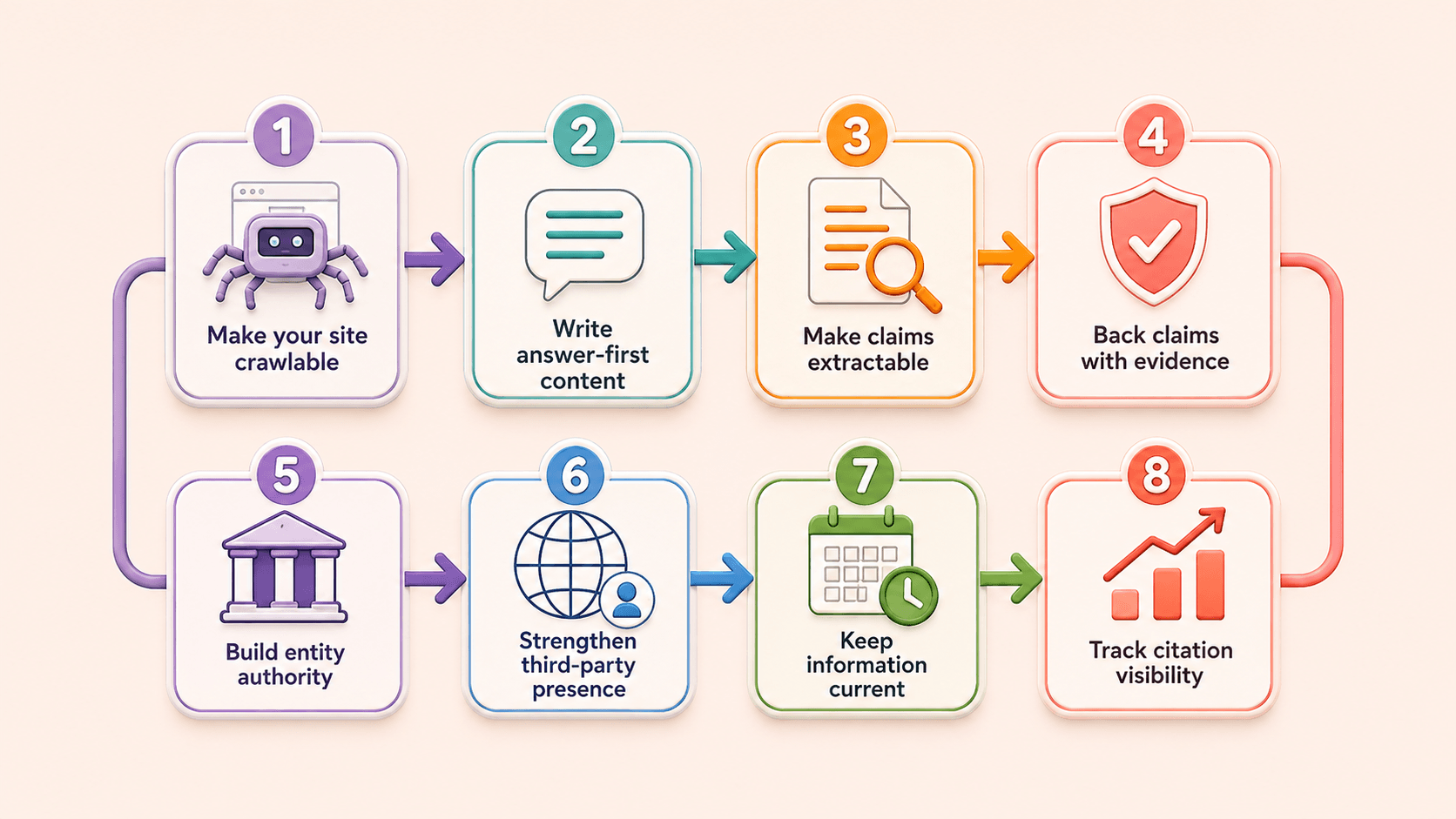
The 8-step framework covered below:
Can You Actually Rank #1 on ChatGPT?
No, ChatGPT doesn’t work the way Google works. Google returns a static ordered list; ChatGPT synthesizes a new answer per prompt, and the sources it pulls can vary by phrasing, session, and time. The right measurement unit isn't a rank position; it's citation presence across a representative prompt set. There's no officially documented selection formula, so what follows separates confirmed fact from inference.
OpenAI has publicly described a general retrieval process: analyze the prompt, query external retrieval infrastructure, evaluate candidate passages, synthesize a response with possible source links. What isn't published is the exact scoring logic behind source selection; treat any claim about precise internal mechanics as inference unless directly sourced to OpenAI's documentation.
8 Ways to Improve Your Visibility
1. Make your site crawlable.
OpenAI documents three agents (crawler documentation):
- GPTBot (training data blocking doesn't necessarily affect Search visibility)
- OAI-SearchBot (live Search indexing blocking can reduce citation eligibility)
- ChatGPT-User (fetches shared URLs). Verify current names/behavior directly, since this can change. Even with open robots.txt, WAF rate-limiting can block crawlers at the edge (403/429) invisibly to your own logs; test directly for HTTP 200, and verify against OpenAI's published IPs rather than user-agent strings alone.
2. Write answer-first content.
Open sections with a direct, self-contained answer before supporting detail.
Before: "SEO has evolved significantly over the past decade..."
After: "ChatGPT Search retrieves web passages and synthesizes them into an answer with citations, rather than returning a ranked list."
This aligns with how retrieval systems generally behave, though it's not an officially confirmed ranking rule.
3. Make claims extractable and verifiable.
One idea per paragraph, specific numbers and dates, named sources, plain definitions. This doesn't guarantee citation alone, but removes friction for extraction.
4. Use evidence and original data.
A KDD 2024 study (Aggarwal et al., "GEO: Generative Engine Optimization") tested generative search engines broadly, not ChatGPT specifically:
| Tactic | Reported Effect |
|---|---|
| Adding statistics/data | ~28-41% visibility improvement |
| Adding source citations | Up to ~40% improvement |
| Expert quotations | ~28-41% improvement |
| Keyword stuffing | Negative (~−10%) |
These come from the study's own tested engines, not ChatGPT directly; treat as directional evidence, not a guaranteed benchmark.
5. Build topical and entity authority.
Cover topics in real depth, use consistent terminology, link related content clearly. No evidence of a proprietary "authority score"; this is just good practice.
6. Strengthen third-party presence.
Reviews, publications, forums, and directories may matter when systems evaluate entities- not a proven direct ranking factor, but reasonable as a broader strategy. Build it through genuine participation; manipulative tactics carry real risk.
7. Keep information current.
Update pricing and specs when they actually change. There's no evidence for a fixed "refresh cadence"; focus on meaningful updates, not cosmetic timestamps.
8. Track citation visibility.
Covered in detail below; one spot-check isn't proof of visibility either way.
What Matters vs. What's Uncertain
| Factor | Evidence Status | Recommendation |
|---|---|---|
| OAI-SearchBot access | Officially documented | Don't block if Search visibility matters |
| Answer-first content | Strong practical rationale | Make answers direct, self-contained |
| Original data | Research-supported (generative engines broadly) | Add genuinely useful evidence |
| Third-party mentions | Observed/emerging | Build legitimate presence |
| Schema markup | Useful for interpretation | Implement accurately; not a ranking boost |
| Keyword repetition | Weak, some negative evidence | Prioritize clarity over density |
What doesn't help: keyword stuffing, thin AI-content volume, fake freshness, assuming Google #1 transfers directly, schema as a shortcut, ignoring third-party presence, chasing a "permanent position," manipulative third-party promotion.
An Original Visibility Research Framework
Rather than citing borrowed statistics, the strongest way to differentiate this guide is original, first-party measurement. The following framework outlines what SEOSorted's own research would track, presented here as a methodology, not as findings, since no statistic should be published before the underlying data is actually collected:
1. Cross-brand citation study — testing a defined prompt set (e.g., 250-500 prompts) across a set of brands (e.g., 50-100), recording mentions, citations, and recommendations.
2. Citation rate by prompt intent — comparing informational, commercial, comparison, transactional, and brand-specific prompts to identify where visibility concentrates.
3. Cited vs. non-cited page analysis — comparing similar pages that are and aren't cited, across factors like direct-answer openings, original statistics, expert quotes, tables, and freshness.
4. Page and source type breakdown — categorizing which formats (blog posts, product pages, comparisons, documentation, third-party reviews) get cited most often.
5. Competitor citation gaps — tracking a fixed prompt set to find where competitors are cited and a target brand isn't, and which sources drive that gap.
Once this data exists, it should be presented with clear methodology (prompt count, sample size, date range), not as a universal ChatGPT ranking rule, but as an observed pattern from a specific, disclosed study.
Measuring Visibility
Distinguish:
- brand mention (named, no link),
- brand citation (named with a link),
- recommendation (actively suggested),
- citation prominence (position, where observable).
Citation Share of Voice = prompts where cited ÷ total tracked prompts × 100.
Competitive Citation Share = your citations ÷ total citations across tracked competitors × 100
Build 20-50 prompts across intents, run on a consistent schedule with consistent location/language settings, and log citation presence, competitors, and dates. ChatGPT referral links may include utm_source=chatgpt.com, though attribution can vary and verify in your own GA4 data rather than assuming universally.
A 5-Step Starting Checklist
- Confirm OAI-SearchBot isn't blocked in robots.txt or your WAF.
- Pick 20-50 prompts across your key topics and intents.
- Audit which competitors are currently cited for those prompts.
- Restructure your top pages into direct-answer, attributable passages.
- Re-run your prompt set monthly and track citation changes over time.
You're not trying to win a single #1 position; that concept doesn't apply here. You're building a source ChatGPT can reliably retrieve, understand, and cite for the prompts that matter to your business. If manual tracking across engines isn't practical at scale, a monitoring platform can automate this- the kind of ongoing work SEOSorted's audit is built to support.
Common questions
No, there's no fixed position. Optimize for citation presence across a tracked prompt set instead.
It can help via overlapping infrastructure, but it's not sufficient alone; ChatGPT evaluates sources independently.
Generally yes if ChatGPT Search visibility matters; blocking it can reduce discovery and citation eligibility.
It can help systems interpret entities, but there's no established evidence it directly boosts citation likelihood.
Possibly, as an observed pattern- not a confirmed ranking factor. Manufactured mentions carry real risk, not genuine benefit.
No, reliable universal timeline; it depends on existing visibility and content quality. Track over consecutive months.
Other Features

How to Rank on Claude: A Practical Guide to Claude Search Visibility
A practical guide to Claude's web-retrieval behavior: what's documented, what's inference, and an 8-step framework to earn citations, not chase a fake rank.

How to Appear on Gemini: A Practical Guide to AI Search Visibility
A practical guide to Gemini's web-retrieval behavior, distinct from Google AI Overviews, with a framework to track citation visibility over time.

How to Appear on Perplexity: A Practical Guide to AI Search Visibility
A practical guide to Perplexity's citation behavior — what's documented, what's observed, and how to track visibility across a tracked prompt panel.

Start building your content library in under 8 minutes.
Your competitors are publishing every week. Every week you don't is a week of organic traffic going to them.
No Credit Card Required.