SEO Content Calendar: How to Plan, Prioritize, and Scale Organic Growth
A practical guide to building an SEO content calendar: a 6-step framework, priority scoring beyond search volume, and how to balance new content with refreshes.

Most content calendars are just publishing schedules with a keyword column bolted on. That's why teams with hundreds of keywords in a spreadsheet still end up publishing based on gut feeling and why traffic often stays flat even at a high publishing cadence. An SEO content calendar is a different thing: an operational system that connects search data, topic clusters, internal linking, and content decay tracking to actual business goals, not just a grid of dates and titles.
A distinction worth making up front: a generic editorial calendar tracks deadlines and headlines. An SEO content calendar links every planned asset to a target keyword, a search intent classification, a topic cluster, pre-mapped internal links, and a refresh trigger. Without those fields, you have a to-do list, not an SEO system.
Why Spreadsheets Break Down
Publishing consistently doesn't guarantee ranking improvements. Google's ranking systems reward content that satisfies search intent and demonstrates real depth — not raw publishing frequency. A content calendar's real job is to sit between keyword research and execution, preventing three specific failures:
Keyword cannibalization — multiple pages competing for the same search intent because there's no central record of what's already been targeted.
Fragmented topical authority — isolated articles instead of complete topic clusters, which search engines read as thinner coverage than it actually is.
Silent traffic decay — legacy pages losing rankings as information ages or competitors publish deeper coverage, while all production capacity goes toward new content.
Manual spreadsheets work fine under roughly 50 assets. Past that, disconnected workflows and stale data make prioritization guesswork. A data-driven or AI-assisted system doesn't replace strategic judgment; it should just handle the mechanical parts (clustering, intent tagging, decay alerts) so people can focus on business alignment and quality.
The 6-Step Framework
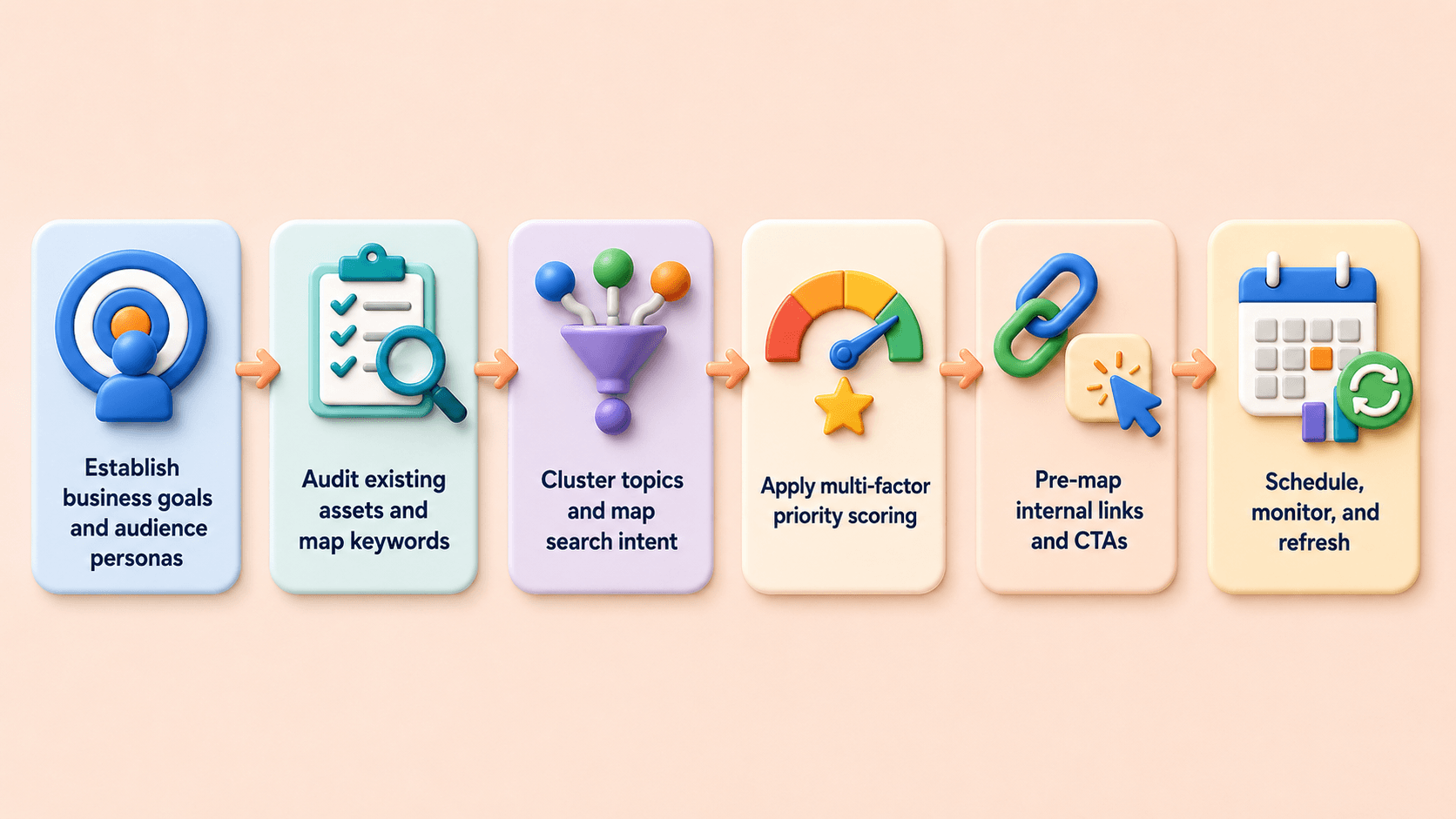
- Establish business goals and audience personas. Define what you're actually optimizing for qualified leads, signups, or revenue before mapping any topic, so content decisions trace back to something concrete.
- Audit existing assets and map keywords. Pull current rankings from Search Console and match target keywords to existing URLs first. This single step prevents most future cannibalization.
- Cluster topics and map search intent. Group keywords into logical clusters, then check top-ranking pages for each primary term to confirm whether the intent is informational, commercial, or transactional; this determines the format the page needs to take.
- Apply multi-factor priority scoring. Covered in detail below, this is where most teams currently rely on search volume alone, which is a weak signal on its own.
- Pre-map internal links and CTAs. Decide which pillar and cluster pages a new article connects to before writing starts, along with the funnel-appropriate CTA.
- Schedule, monitor, and refresh. Input prioritized briefs, track post-publication performance, and trigger refreshes when decay thresholds are met, treating maintenance as a scheduled part of the system, not an afterthought.
Prioritizing by More Than Search Volume
Sorting keyword lists by volume alone routinely surfaces broad, highly competitive terms with weak commercial intent. A more defensible model weighs several factors together:
Priority Score = (Business Value × 0.35) + (Search Opportunity × 0.25) + (Topical Importance × 0.25) + (Content Gap × 0.15) − Production Effort
| Factor | What It Measures |
|---|---|
| Business Value (1-5) | Alignment with product capabilities or revenue conversion |
| Search Opportunity (1-5) | Volume weighed against difficulty and intent fit |
| Topical Importance (1-5) | How critical the topic is to completing a cluster |
| Content Gap (1-5) | How thoroughly current search results already answer the query |
| Production Effort (1-5) | Research, design, or interview time required |
This is a practical scoring heuristic, not a formula Google uses its value is forcing a consistent comparison across candidate topics rather than defaulting to whichever has the biggest volume number.
Organizing Around Topic Clusters, Not Isolated Keywords
A topic cluster pairs a comprehensive pillar page with supporting subtopic articles, connected through deliberate internal linking. Four link pathways matter here:
- Pillar → cluster— the pillar links down to every supporting article.
- Cluster → pillar — every supporting page links back up within its body text.
- Cross-cluster — related subtopic pages link to each other where relevant.
- Legacy → new — when publishing a new article, existing relevant pages get scheduled updates linking forward to it.
The key operational point: these links should be pre-mapped in the calendar before drafting begins, not added as an afterthought once a piece is live. Treating internal linking as a post-publish task is one of the most common gaps in generic content calendars.
Balancing New Content With Refreshes
Traffic decays. Competitors publish deeper coverage, facts go stale, and pages that ranked well a year ago quietly slip. A calendar focused only on new publishing guarantees this decay goes unaddressed. A reasonable practice: reserve roughly 20-40% of monthly production capacity for updating existing pages rather than only creating new ones.
A simple triage model helps decide what action a decaying page needs:
| Trigger | Likely Issue | Action |
|---|---|---|
| Organic traffic down >20% quarter-over-quarter | Content losing freshness or competitors expanding coverage | Update and expand |
| Ranking drops from page 1 to page 2 | Intent mismatch or SERP format shift | Restructure to match current top-ranking format |
| Multiple pages targeting similar keywords | Internal cannibalization | Consolidate into one asset and redirect the rest |
| Page targets a now-irrelevant query | Shift in business focus | Retire or noindex |
These specific percentage and threshold figures are practical starting points drawn from general content-strategy practice, not universal rules; adjust them based on your own traffic patterns and review cadence.
Workflows by Team Type
| Team Type | Cadence | Focus |
|---|---|---|
| Solo SEO/consultant | ~2 new posts + 1 refresh/month | High-impact topics, quarterly refresh reviews |
| Small content team | ~1 article/week + 2 refreshes/month | Structured handoffs: brief → draft → edit → SEO check |
| SaaS company | 2–3 cluster posts/week | Product-led topics, feature-comparison queries, signup CTAs |
| Ecommerce | Seasonal, high-volume | Category and buying-guide content tied to retail cycles |
Rolling 90-day windows tend to work better than rigid 12-month plans. SERPs shift due to algorithm updates and competitor activity often enough that a full year mapped out in advance risks becoming outdated before it's executed.
What to Track in the Calendar
- Essential fields: working title, primary keyword, search intent, topic cluster, owner, production status, target publish date.
- Recommended fields: secondary keywords, search volume, keyword difficulty, business value score, funnel stage, target URL, pre-mapped inbound/outbound links, target CTA.
- Advanced fields: target SERP content format, competitor baseline URL, content refresh trigger status, AI-search citation visibility.
Skip generic brainstorm notes and manual word-count targets unsupported by actual SERP analysis; these add clutter without operational value.
Where AI Fits and Where It Shouldn't
AI tools can meaningfully speed up keyword clustering, intent tagging, decay detection, and initial brief generation. What they shouldn't replace: business-alignment judgment, priority validation, brand voice, and genuine first-hand expertise in the final content. Unmonitored AI-driven planning risks producing keyword cannibalization or thin, off-brand recommendations that don't map to what the business actually offers. The fix is keeping a human checkpoint at brief review and final priority calls, not avoiding automation altogether.
Quick Takeaways
- Prioritize business value and intent fit over raw search volume.
- Organize production around complete topic clusters, not isolated keywords.
- Pre-map internal links in the brief, before drafting starts.
- Reserve real production capacity for refreshing legacy content, not just publishing new pieces.
- Plan in rolling 90-day windows rather than rigid annual calendars.
- Let AI handle clustering and tagging; keep humans on priority and quality decisions.
Common questions
An operational system that plans, schedules, and tracks content creation and updates based on search intent, keyword data, topic clusters, and business goals, distinct from a generic publishing schedule.
A traditional editorial calendar tracks deadlines, titles, and authors. An SEO content calendar adds target keywords, search intent classification, topic cluster assignment, pre-mapped internal links, and decay tracking.
Not directly. Google's ranking systems evaluate intent satisfaction and content quality rather than publishing frequency. A strict schedule that produces thin content can hurt more than help.
A rolling 90-day window, reviewed monthly, tends to hold up better than a rigid 12-month plan, since SERPs and competitive coverage shift over time.
Combine business value, search intent fit, topical cluster relevance, and competitive difficulty rather than sorting by search volume alone.
Roughly every 90 days is a reasonable starting cadence; flag pages for update when traffic drops meaningfully, or the underlying information is outdated, rather than on a fixed calendar alone.
Other Features

How to Rank on ChatGPT: A Practical Guide to ChatGPT Search Visibility
A practical guide to ChatGPT Search visibility: what's confirmed, what's inference, and an 8-step framework to earn citations, not chase a fake #1 rank.

How to Rank on Claude: A Practical Guide to Claude Search Visibility
A practical guide to Claude's web-retrieval behavior: what's documented, what's inference, and an 8-step framework to earn citations, not chase a fake rank.

How to Appear on Gemini: A Practical Guide to AI Search Visibility
A practical guide to Gemini's web-retrieval behavior, distinct from Google AI Overviews, with a framework to track citation visibility over time.

Start building your content library in under 8 minutes.
Your competitors are publishing every week. Every week you don't is a week of organic traffic going to them.
No Credit Card Required.