
Your keyword spreadsheet might be hurting your rankings. Automated keyword research exists because the bottleneck in SEO is no longer collecting data. It's deciding which queries deserve their own page, and a Google Sheet can't make that call.
Without live SERP overlap checks, manual mapping drifts straight into cannibalization: several posts chasing one search intent, none of them winning. You already know search volume, KD, and intent categories. What you're missing is a way to turn seed terms into one URL per intent without a week of VLOOKUPs.
This guide covers where spreadsheet research breaks, how AI-driven clustering actually works, and a four-step framework you can run this quarter.
The Structural Failure of Spreadsheet-Based Keyword Research
Spreadsheets are static artifacts. The moment you export a list, it starts going stale, and everything you build on top of it inherits that decay.
The Hidden Cost of Manual Data Cleanup and VLOOKUP Workflows
Teams describe losing eight or more hours per content cluster just formatting Semrush or Ahrefs exports, removing irrelevant terms, and splitting text to columns. That's strategist time spent on janitorial work. The same pattern shows up everywhere:
- A 3,000-row sheet creates analysis paralysis, with no clear answer on which URL to build first.
- Custom scripts and connector integrations break, so keyword research turns into a maintenance job.
- Research sits in Drive files, disconnected from briefs, writer handoffs, internal links, and the CMS.
- Different team members cluster terms with different subjective logic, which fragments site architecture.
Most guides tell you to keep refining the sheet. That's wrong because the sheet is the problem. Treat raw tables as transient inputs, not as the plan.
The damage isn't only the hours. Publishing schedules slip while the plan goes obsolete, so the team ships against a map that's already out of date.
How Static Keyword Mapping Triggers Keyword Cannibalization
Human reviewers can't reliably predict how a search engine interprets thousands of query variations. Labeling intent by hand produces overlapping pages, and nobody notices until traffic stalls.
Picture a project management SaaS launching an automated resource scheduling feature. The SEO manager exports 1,500 keywords, spends six hours filtering them, and ships five articles: tools, software, best schedulers, how to schedule resources, and automated allocation. Google ranks a competitor's single pillar page for all five queries, so the five posts compete with each other and stall on page three.
Understanding AI-Driven Automated Keyword Research
Automated keyword research replaces the export-clean-guess loop with a pipeline. It gathers long-tail queries, semantic variants, and live SERP data from a seed topic or competitor URL, then groups terms into URL-ready clusters.
Real-Time SERP Analysis vs. Static Historical Databases
A database export tells you what a keyword looked like when the snapshot was taken. Live SERP analysis tells you what search engines are ranking right now, which is the only evidence that matters for intent. When the results shift, your clusters should shift with them.
Algorithmic Clustering: Semantic Grouping and SERP Co-Occurrence
Semantic clustering groups terms by linguistic similarity. SERP co-occurrence groups them by whether search engines rank the same URLs for those queries. The second method wins the argument, because it reflects what the algorithm actually believes rather than what a human assumes.
Back to the scheduling example. An engine scanning live results finds that "software," "tools," and "automated allocation" share an 80% URL co-occurrence score. It consolidates them into one commercial feature page and assigns "how to schedule resources" to a single informational guide. SEOSorted runs this live SERP analysis during research, so overlapping terms land in one cluster before anyone writes a brief.
This also changes how you rank priorities. A high-volume keyword with ambiguous intent converts worse than a tight cluster of low-volume, high-intent long-tail phrases. Judge a cluster by its combined business value and topical co-occurrence, not by the biggest number in one row.
Manual Keyword Research vs. Automated Keyword Research Workflows
The difference isn't speed alone. It's whether each stage hands clean output to the next one.
The Data Extraction and Cleaning Phase
The legacy route means exporting thousands of raw queries to CSV, deleting duplicates, stripping brand modifiers, splitting text to columns, and standardizing difficulty metrics. Every one of those steps is manual, and every one can introduce an error. The automated route starts with a seed topic and returns gathered, cleaned queries with live SERP data already attached.
Intent Classification and URL Architecture Mapping
Manually, someone runs formulas to guess intent, groups queries into temporary sheets, and assigns clusters to URLs by judgment. That's where cannibalization gets baked in. Automated workflows tag each cluster as commercial, transactional, or informational, and isolate unassigned terms so they can't quietly spawn a duplicate page.
Bridging the Execution Gap from Brief to CMS
In the spreadsheet world, approved keywords get copied into separate documents to build briefs for writers. Then someone formats the draft for Webflow or WordPress by hand. Each handoff loses optimization data.
Consider an agency running twelve client accounts at eight articles per client each month. If strategists spend forty hours monthly on spreadsheets, VLOOKUP scripts, and manual briefs, a large share of billable time goes to formatting instead of strategy or quality review. Automated blueprints generated in minutes remove that tax, so output can grow without adding operational headcount.
Step-by-Step Framework for Automated Keyword Research
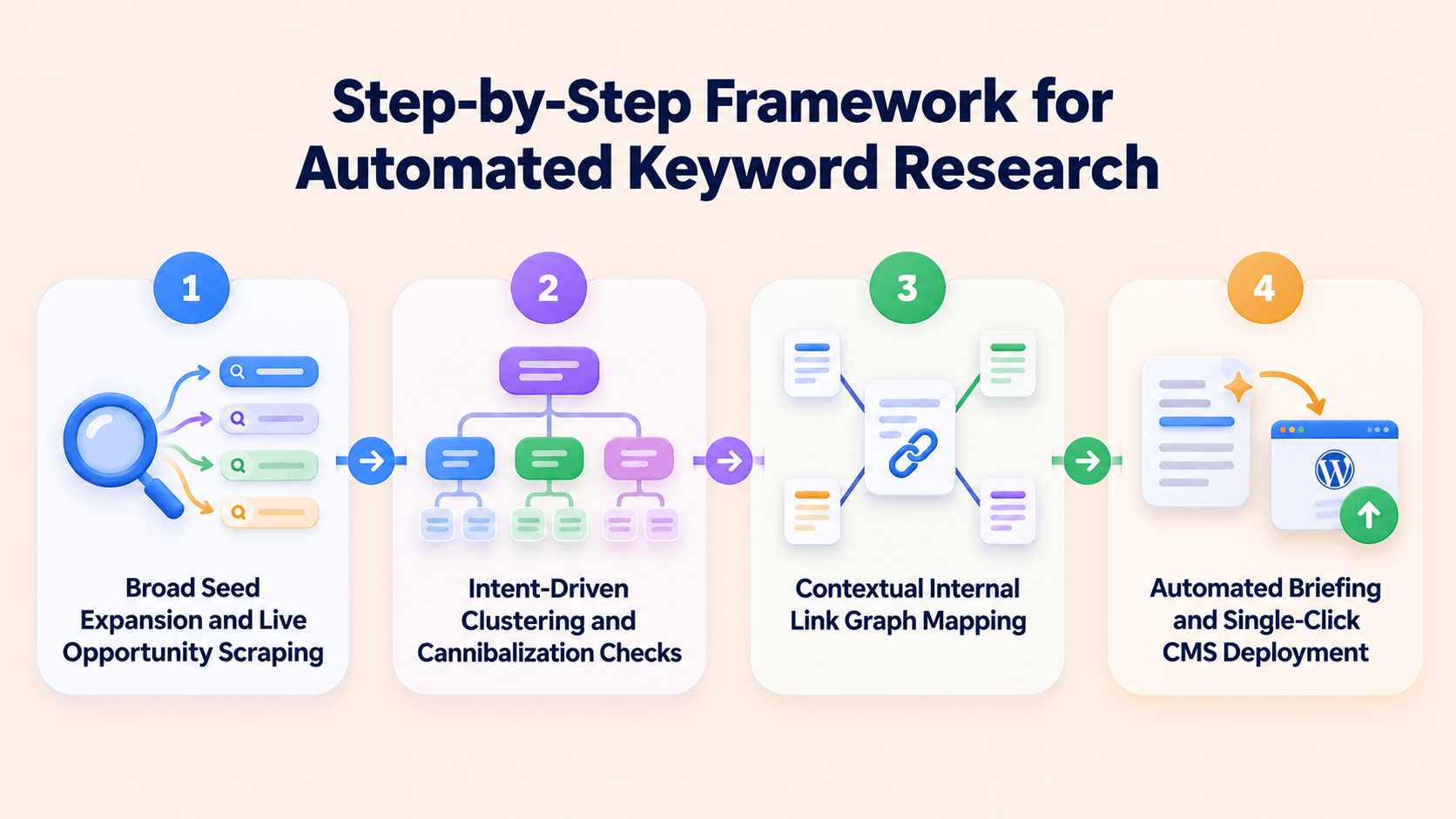 Here's the workflow, in order. Run it once per topic area, then repeat.
Step 1: Broad Seed Expansion and Live Opportunity Scraping
Enter a seed topic or competitor URL and let the engine gather long-tail queries, semantic variants, and live SERP data. Don't prune by hand at this stage. Pruning before clustering throws away the terms that often reveal how a topic splits across intents.
Step 2: Intent-Driven Clustering and Cannibalization Checks
Group terms by SERP co-occurrence, then tag each cluster by intent. Anything that doesn't fit stays unassigned instead of being forced into a page. Never bundle a commercial investigation query with a broad informational one in the same brief, because that mix is how you get high bounce rates and weak conversion. If you want a quick way to see how a topic splits, the free content cluster generator is a reasonable place to start.
Step 3: Contextual Internal Link Graph Mapping
Isolated briefs force writers to hunt through the site for linking opportunities. Map each new cluster against existing indexed URLs first, so contextual links go into the content as it's generated and new articles connect to your existing pillar pages. Automated internal linking handles this mapping and embeds anchor-text-optimized links during generation.
Step 4: Automated Briefing and Single-Click CMS Deployment
Inject the approved cluster straight into a structured brief, generate the optimized content, and push it to your CMS as a draft. With SEOSorted, that means Webflow, WordPress, or a custom endpoint, with cluster rankings tracked after publishing. No exported brief documents, no manual reformatting.
Then put a recurring check on the calendar. Re-audit clusters quarterly to catch shifting intent, and merge underperforming URLs where search results have consolidated.
Evaluating Automated SEO Platforms vs. Legacy Tool Stacks
Most tools in this space do one job well and stop there. Judge them by where the work ends.
- Traditional keyword suites give you huge databases and raw tables. The cleanup and spreadsheet mapping still land on your team.
- Spreadsheet connectors automate data transport, but you keep maintaining the formulas and filtering intent manually.
- Standalone clustering tools group keywords well but end at a CSV. Briefs, content, and internal links still live in other apps.
Then there's generic AI. A founder pastes seed terms into an unassisted chatbot and gets confident output, but the model can invent search volume figures, can't see live rankings, and can't calculate SERP overlap. The result bundles conflicting intents into single articles that fail to rank.
When you evaluate any platform, ask four questions:
- Does it cluster from live SERPs rather than static exports?
- Does it check for cannibalization before content exists?
- Does it map internal links to existing pages?
- Does it publish to your CMS?
Stop treating research, briefs, links, and publishing as four separate jobs. Try SEOSorted and take your next topic from seed term to published draft in one workflow.
Common questions
AI automates keyword research by querying search results in real time, analyzing intent patterns, and grouping related terms into topic clusters. This replaces manual CSV exports, duplicate filtering, and spreadsheet categorization, producing a URL-mapped content architecture instead of a flat list of keywords.
Yes, it can. Automated keyword research calculates SERP co-occurrence scores across target queries. When several keywords show overlapping top-ranking URLs, the system groups them into one cluster, so each published page targets a distinct search intent instead of competing with a sibling page.
Spreadsheet research is inefficient because manual exports need hours of cleaning, column reformatting, and VLOOKUP matching, and the result goes stale quickly. Spreadsheets also lack live SERP validation, so intent shifts are hard to detect and research never connects directly to content execution.
Semantic clustering groups terms by grammatical and linguistic similarity, while SERP clustering groups them by whether search engines rank identical pages for those queries. Modern automated platforms combine both methods, which keeps clusters coherent in meaning and aligned with how search engines actually return results.
No. Generic AI prompts lack live access to current search rankings and can invent search volume figures. They also can't calculate SERP overlap, so they tend to bundle conflicting intents into one article. Dedicated automated keyword research validates clusters against live results before any content gets written.
Related Reading

What Does SEO Position Mean? A Practical Guide for Growth Teams
SEO position is the spot a page holds on a search results page, not the job title. This guide shows why average position misleads and how to track and improve rankings by intent, device, and location.

SEO Automation Tools: What Can (and Can't) Be Automated for Organic Growth
A decision framework for choosing an SEO automation tool: which tasks can be fully automated (SERP research, internal linking, schema, CMS publishing, tracking), which still need human judgment, and how advisory suites differ from closed-loop execution engines.

LSI Keyword Generator Myth vs. Modern Semantic SEO
A debunk-and-deliver guide to the LSI keyword generator myth: why Google doesn't use Latent Semantic Indexing, how legacy term checklists hurt AI Overview visibility, and how live SERP entity mapping replaces them from research through CMS publishing.