How to Build Topical Authority: An Engineering-Level Framework
An engineering-level framework for building topical authority covering siteFocusScore, siteRadius, hub-and-spoke cluster architecture, and how to earn citations across ChatGPT, Perplexity, and AI Overviews instead of just Google rankings.

Publishing 25 blog posts in a quarter and watching total organic traffic barely move isn't a content problem; it's a topical authority problem. You're ranking on page three for dozens of terms, while a competitor with half your Domain Rating ranks on page one for every commercial keyword that matters, because their site is a tightly bounded knowledge base and yours is a scattered archive.
You already know what a backlink is and what Domain Rating measures, so this isn't another definition post. This is the operational mechanics: how Google's vector embedding models score topical focus, why that score matters more than your DR, and the exact cluster architecture that turns fragmented posts into something search engines and AI answer engines treat as authoritative.
Get this wrong, and every core algorithm update keeps hitting you the same way: a 20% traffic drop because your domain reads as unfocused. Get it right, and a DR 15 site can outrank a DR 96 competitor on the terms that convert.
Topical Authority vs. Domain Rating: What Actually Gets Measured
Domain Rating and Domain Authority estimate backlink strength. Neither is a direct Google ranking signal, and neither reflects how search engines actually evaluate a site. Google's internal systems score authority topic by topic, not domain-wide, which is why a specialized DR 15 site can consistently outrank a generalist DR 96 domain when its semantic coverage and internal link topology are tighter.
The mechanics run through vector space models. In Google's site2vec approach, every page you publish either tightens or loosens your site's position in topical space. Two metrics do the work: siteFocusScore measures how concentrated your content is around a core subject, and siteRadius measures the mathematical distance between your pages and that center. Publish off-topic content to chase top-of-funnel volume, and you widen your site. Every tangential post drags siteFocusScore down and makes the algorithm less confident in your core expertise, which suppresses rankings on the revenue pages you actually care about.
That distinction matters operationally: topical authority is the outcome search engines confer on you. Topical cohesion, tight boundaries, deterministic internal linking, and zero orphan pages are the strategies you actually control to earn it.
Most SEO tooling still treats this as a keyword-list exercise. Ahrefs and Semrush frame clusters as seed keyword expansion and pillar-and-subpage structures you build manually, with no connection to a site-wide focus metric. That's fine for mapping a cluster on paper. It doesn't help you catch the fact that a post you published eighteen months ago is quietly widening your siteRadius right now.
Why Topical Cohesion Beats Backlinks for Traffic and AI Citations
A cloud compliance SaaS platform at DR 28 tried to rank for "cloud security frameworks" by publishing broad 2,000-word guides like "cloud security tips" page-four indexation, zero traffic. It rebuilt around a single pillar page, "The Complete Guide to Cloud Compliance Frameworks," backed by 12 tightly interlinked cluster pages on subtopics like SOC 2 Type II audits and HIPAA cloud storage encryption. Within 120 days, it held position #2 for the primary term and picked up AI Overview placements across 85 related fan-out queries, outranking enterprise sites at triple its Domain Rating.
An e-bike conversion kit retailer at DR 15 did the same against Amazon's DR 96: it cut its general cycling content, narrowed its siteRadius to conversion mechanics specifically, and built out sub-pages on battery voltage compatibility and state-specific wattage regulations. It landed top-three organic positions and dominant AI summary citations for e-bike conversion specs, proof that topical focus overcomes a massive backlink deficit.
That AI-citation piece isn't optional anymore. Generative platforms use Retrieval-Augmented Generation and query fan-out to split one prompt into multiple sub-queries, then retrieve information chunks from sites that map complete entity relationships. Shallow keyword coverage gets ignored; deep subtopic coverage compounds into citations across ChatGPT, Perplexity, and AI Overviews.
The Step-by-Step Framework to Build Topical Authority
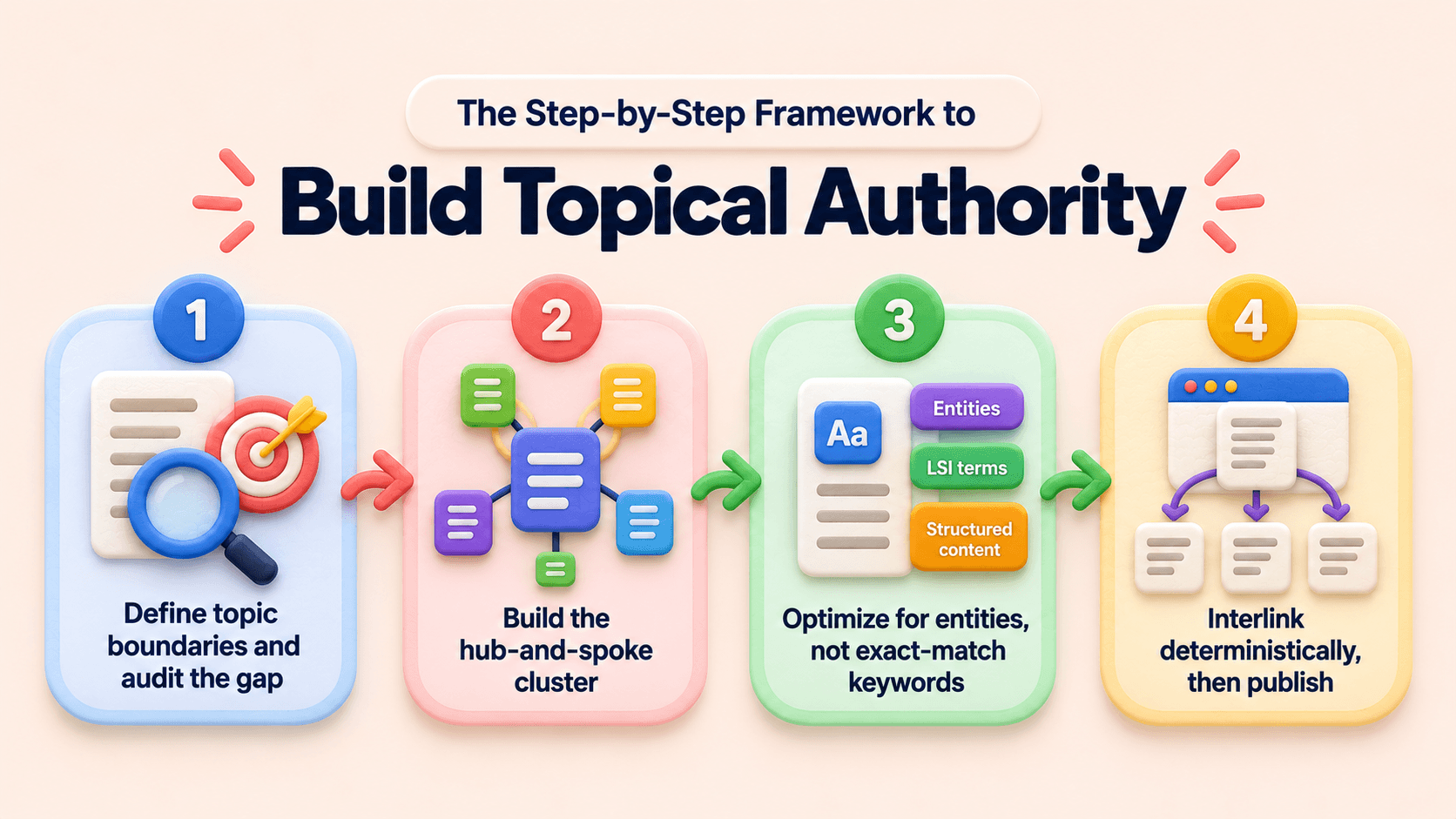
Step 1: Define topic boundaries and audit the gap. Pick a seed entity narrow enough to own completely "B2B SaaS churn reduction," not "marketing." Run a competitive content gap analysis against the niche domains actually ranking, and audit your existing URLs for high-siteRadius pages dragging your focus down. The most common failure here is targeting terms too broad to defend or refusing to prune content that no longer fits.
Step 2: Build the hub-and-spoke cluster. One pillar page, 8 to 15 cluster subpages, with search intent mapped across informational, commercial, and comparison stages. Pull sub-queries straight from AI query fan-out patterns instead of guessing. Publishing cluster pages before the pillar exists is the fastest way to create duplicate content and cannibalize your own rankings.
Step 3: Optimize for entities, not exact-match keywords. Work semantic entities and LSI vocabulary naturally into headers and body copy, structure sections for AI extraction with clear definitions, tables, and lists, and back claims with expert bylines and primary data. Surface-level fluff that never reaches long-tail query depth is the single biggest reason clusters underperform.
Step 4: Interlink deterministically, then publish. Every cluster page links back to the pillar, and the pillar links out to every cluster page with descriptive, entity-rich anchor text, never a generic footer link that passes no contextual value. This is the step that breaks down first when it's done by hand: a team scaling cluster output on spreadsheets loses track of which posts still need linking back, and a live SERP and AI fan-out mapping engine that generates the hub-and-spoke structure automatically, then injects contextual internal links into the right paragraphs, closes that gap without a manual audit.
Mistakes That Quietly Destroy Topical Focus
An agency scaling a marketing automation client to 50 posts a month with generic AI writers is the clearest failure mode in the research. The tool generated broad, surface-level articles that wandered into tangential territory the history of printing presses and general sales team management. Every off-topic page widened the site's siteRadius and dragged down siteFocusScore, and rankings for "marketing automation workflows" dropped 35% as Google lost confidence in the site's core focus.
Watch for these patterns:
- Publishing tangential content for top-of-funnel volume instead of staying inside your topic boundary
- Cluster subpages that never link back to the pillar, or that rely on weak sidebar and footer links
- Generic AI output that drifts into unrelated subtopics because nothing is enforcing entity boundaries
- Measuring success by Domain Rating instead of unbranded keyword coverage and topical share of voice
Measuring Topical Authority: What to Actually Track
Track unbranded keyword visibility and topical share of voice across your cluster, not just individual page rankings. Track AI citations across ChatGPT, Perplexity, and AI Overviews alongside traditional SERPs. A cluster that ranks well but earns zero LLM citations still has a coverage gap somewhere. Refresh aging cluster pages and close new competitor gaps before they open a hole in your siteRadius. Most teams manually track SERP rank in one tool and have no visibility into AI platform citations at all; consolidating unbranded rank and AI visibility tracking into one view is what actually catches drift before a core update punishes it.
Building and maintaining a real cluster by hand mapping fan-out queries, auditing siteRadius, injecting links, and tracking citations is weeks of spreadsheet work per topic. SeoSorted runs that as one pipeline: live SERP and AI fan-out mapping to build the hub-and-spoke structure, deterministic contextual linking across the cluster, and unified tracking across Google and the major LLM answer engines.
Stop measuring your content strategy by how many posts you shipped this quarter. Try SeoSorted free and map your first topic cluster against live SERP and AI fan-out data instead of a spreadsheet.
Common questions
Topical authority is a search engine's assessment of a site's depth, expertise, and credibility across an entire subject area. Search engines evaluate whether a domain functions as a comprehensive knowledge base by analyzing semantic entity coverage, interlinking structure, and content focus, not just individual keyword matches or backlinks.
You build topical authority by creating structured content clusters that cover every subtopic and entity within a seed topic. That means a central pillar page, interlinked subtopic articles, mapped semantic search intent, tight topical focus, and pruning off-topic content that causes algorithmic drift.
Topical authority measures content depth and semantic coverage on a specific subject. Domain Authority (or Domain Rating) is a third-party metric estimating overall site strength based mainly on backlinks. Google's internal systems evaluate topics directly. Domain Rating isn't a Google ranking signal at all.
Building topical authority typically takes three to six months of systematic content publishing and internal link deployment. That timeline moves faster or slower depending on publishing velocity, how complete your cluster is, how many existing content gaps you close, and how often search engines crawl your newly connected pages.
There's no fixed article count; it depends on how broad your seed topic is. A narrow niche can be covered in 10 to 15 tightly interlinked pages, while a complex industry may need 50 to 100+ subtopic articles to cover every intent variant and query fan-out path.
Related Blogs

SEO for Small Business: A Practical 90-Day Guide
Improve rankings and attract qualified customers with a focused 90-day SEO roadmap covering technical fixes, keywords, content, and workflows. See the guide.