
A direct competitor publishes twenty targeted articles across an unaddressed product subtopic in thirty days, capturing high-intent category search traffic while your team is still structuring a single content brief. Every week spent manually deduplicating search queries and drafting from scratch expands the gap further, and by the time the brief is approved, the subtopic that used to be open territory already has an entrenched leader.
Content gap analysis was never actually about finding the missing keywords; legacy tools already surface those in a 5,000-row CSV export that then sits untouched in Google Drive for weeks. The real bottleneck is turning that export into clustered, internally linked, published pages before competitors consolidate the market share, and that bottleneck hits SaaS founders, marketing managers, and agency directors in slightly different ways: founders lack editorial headcount, managers hit roadmap-planning delays from manual sorting, and agencies burn billable hours transitioning audits into live assets.
This is the step-by-step framework for running that audit at the cluster level instead of the keyword level, plus the pitfalls: spreadsheet paralysis, orphaned pages, generic AI drafts that quietly stall most teams before a single article goes live.
What Is a Content Gap Analysis in Modern SEO?
Keyword Gaps vs. Structural Topic Cluster Gaps Most guides tell you to map individual URLs to isolated search terms. That's outdated. Modern search engines group related queries under unified intent umbrellas using semantic and SERP-similarity processing, so gap analysis has to happen at the cluster level, or you end up publishing thin, redundant pages that cannibalize each other instead of building anything.
Generative AI and AI Overview Citation Gaps There's a second gap most audits miss entirely: the AI citation gap, where generative search models like AI Overviews reference a competitor as the category authority while omitting your brand completely. Traditional gap audits built around ten-blue-link rankings are blind to this by design, which means a domain can look competitively healthy on paper while losing the newer discovery channel entirely.
Step-by-Step Framework for Executing a Content Gap Audit
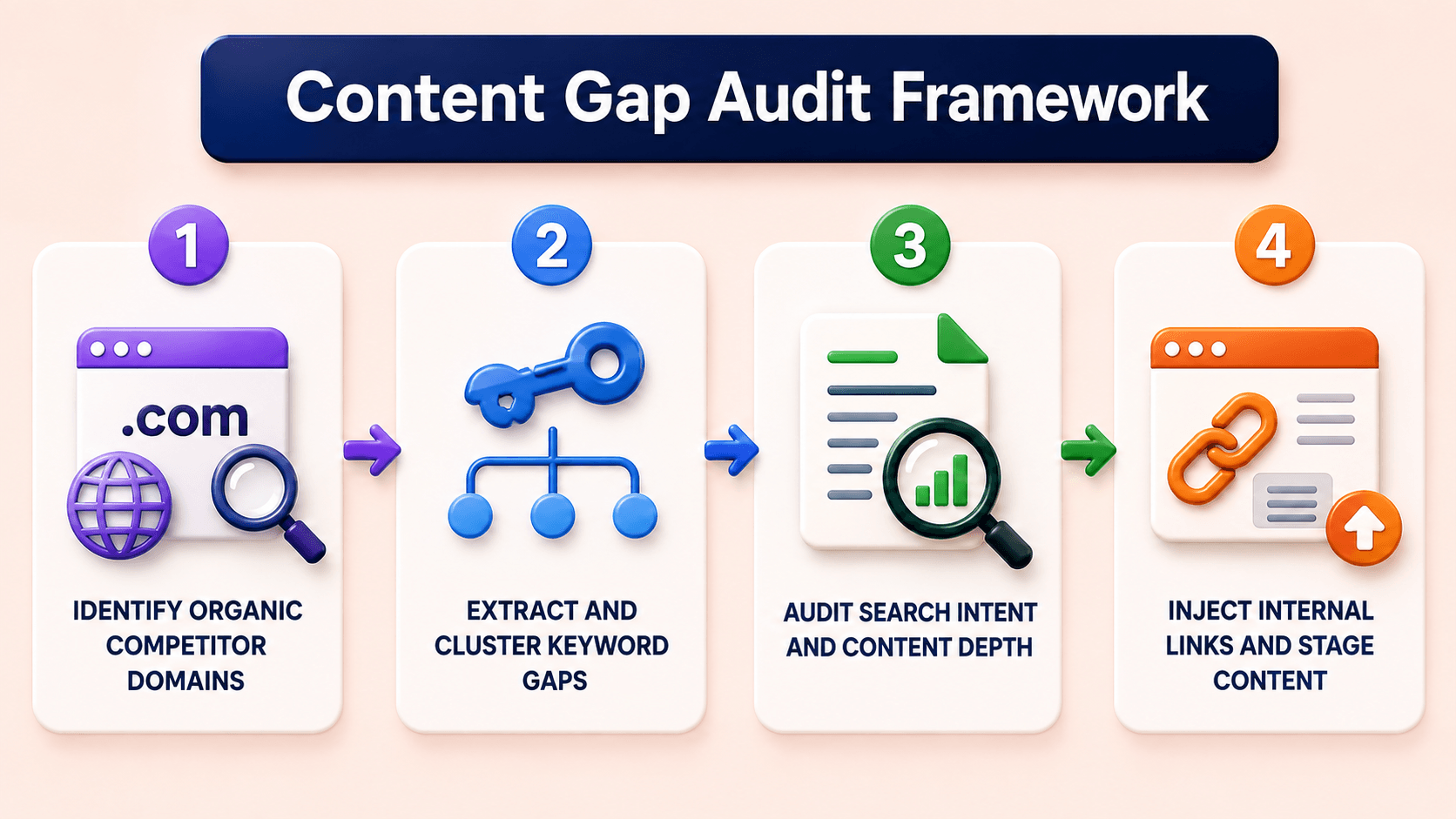
Step 1: Identify organic competitor domains. Pick three to five direct organic competitors' domains that consistently capture your target audience across core commercial and informational queries, not the broadest players in your category. Extract their organic keyword profiles and isolate queries where multiple rivals rank in the top twenty while you're unranked entirely, since that overlap is the strongest signal of a genuine, defensible gap rather than a one-off ranking fluke.
Step 2: Extract and cluster keyword gaps. This is where most audits go generic, and it's the step that actually determines whether the rest of the framework works. Run the raw export through SERP similarity analysis group queries that return identical or near-identical top-ranking URLs into one cluster instead of treating each as a separate target, which is what prevents the internal keyword cannibalization that single-keyword mapping creates. "Group your keywords into themes" is vague advice that doesn't hold up; the actual mechanic is comparing which URLs occupy the top results for each query and merging queries whose result sets overlap heavily, since that overlap is the signal that search engines are already treating those queries as one intent. Then classify each cluster by intent: informational reference, commercial comparison, or product landing page before a single brief gets written.
Step 3: Audit search intent and content depth. Check what's actually satisfying each cluster's top results before you brief anything. Depth of subtopic coverage, format, and structure matter more here than matching a target keyword density, since that's what the ranking pages are actually being rewarded for.
Step 4: Inject internal links and stage content. Convert each cluster into a structured brief heading hierarchy, secondary terms, and core user questions, then map internal links to existing live URLs before publishing, not after. A page that goes live without that mapping stays orphaned, and orphaned pages are exactly what slows indexation down in the first place.
One Series A project management SaaS learned this the hard way. Publishing isolated articles against broad terms like "project management software" and "task tracking tools" left organic traffic flat despite a weekly publishing cadence; the pages had no internal link connections, and the domain's topical authority stayed thin. Switching to cluster-based targeting, the team isolated an unaddressed "agile resource capacity planning" cluster of 14 interconnected queries, built a pillar page with 13 supporting articles and automated internal linking, and captured top-five positions across the entire cluster within eight weeks.
Common Content Gap Analysis Pitfalls to Avoid
Targeting isolated keywords without cluster support is the fastest way to cannibalize your own rankings. A single asset should satisfy multiple intent variations inside a cluster, not compete against three other pages on your own domain for the same query.
Leaving competitive data in a static spreadsheet is the second failure, and it's the more common one. Growth teams routinely spend weeks manually sorting thousands of rows with formulas, introducing errors and delays, while the competitive opportunity the export identified keeps getting captured by whoever moves faster. Generic AI drafting compounds both failures at once: tools without real-time SERP parsing produce surface-level, repetitive descriptions for each keyword without recognizing the structural relationships between them, which creates exactly the redundant pages search algorithms filter out as low quality.
| Operational Stage | Standard Manual Strategy | Automated Execution Model |
|---|---|---|
| Competitor harvesting | Manual CSV exports from legacy databases | Automated competitor domain SERP analysis |
| Keyword clustering | Sorting keywords in spreadsheets | Algorithmic SERP similarity clustering |
| Brief generation | Manual review of top 10 results per term | Real-time SERP intent parsing and outline building |
| Internal link mapping | Manual search of live site index for anchors | Contextual internal link mapping |
| Asset publishing | Copy-pasting text into CMS editors | Direct automated CMS draft deployment |
Automating Your Content Gap Execution Pipeline
Most existing coverage stops at diagnostic reporting. Ahrefs and Semrush surface deep competitor keyword overlaps but require manual export, manual clustering, and a separate writing workflow; Surfer and Clearscope score individual pages against SERP averages but have no domain-level cluster planning or publishing pipeline at all. Neither category closes the loop between finding a gap and shipping a page for it.
| Capability | Semrush / Ahrefs | Surfer / Clearscope | SeoSorted |
|---|---|---|---|
| Core focus | Domain research and historical tracking | Single-URL term density scoring | End-to-end automated organic pipeline |
| Keyword clustering | Manual spreadsheet exports | Basic page-level suggestions | Built-in SERP-based algorithmic clustering |
| Internal link generation | Passive audit reports only | None available | Programmatic contextual injection |
| CMS publishing | None, manual copying required | WordPress plugin, manual editing | Automated one-click publishing |
SeoSorted groups gap keywords by SERP similarity automatically instead of handing back a raw export, scans your live URL inventory to inject contextual internal links during generation so nothing publishes orphaned, and pushes the finished asset straight to your CMS with rank tracking already running on the cluster.
A 20-client agency running this manually spent the first week of every month on audits and briefs alone, with freelance writers taking three weeks per draft output, capped at four articles per client per month. Consolidating discovery, clustering, drafting, and linking into one workflow took that to twenty-four published articles per client monthly, without adding editorial headcount.
Common questions
Content gap analysis is the process of identifying missing topics, keywords, and subtopics that competitors rank for but your website doesn't. Auditing these voids across search intent stages lets you create targeted content that expands search visibility and builds domain-level topical authority, rather than guessing at what to publish next based on internal opinion alone.
It surfaces the missing subtopics across your domain's core themes specifically, not just individual missing keywords. Publishing a comprehensive content network that addresses those unaddressed queries demonstrates subject matter expertise to search engines directly, which boosts rankings across the entire cluster instead of just the one page you happened to write.
Semrush and Ahrefs handle competitor keyword discovery well; Bing Webmaster Tools helps track AI citation gaps specifically; and SeoSorted converts identified gaps into clustered, internally linked, published content automatically. Most teams end up needing a combination, since discovery and execution have historically lived in entirely separate tool categories.
Every three to six months, as a general cadence. That frequency tracks evolving competitor strategies, search algorithm updates, and shifting customer search behavior closely enough that your content roadmap stays aligned with real commercial opportunity instead of drifting out of date between audits.
It's when generative search models like Google AI Overviews cite a competitor as the category authority for a query while omitting your brand entirely, even if you rank well on traditional results. Traditional rank-tracking audits built around ten-blue-link positions don't catch this, which means a domain can look competitively fine on paper while losing this channel outright.
Related Reading

Content Cluster Strategy: A 4-Step Framework for Stalled Pillar Pages
Most stalled pillar pages are cluster design problems, not writing problems. This guide gives a four-step framework for intent mapping, pillar and spoke structure, and bidirectional linking, plus how to automate cluster upkeep.

Automated Keyword Research: How AI Replaces the Spreadsheet
Spreadsheets turn keyword research into cleanup work and cannibalization risk. This guide shows how AI clusters keywords by live SERP overlap, and gives a four-step framework for going from seed term to published draft.

What Does SEO Position Mean? A Practical Guide for Growth Teams
SEO position is the spot a page holds on a search results page, not the job title. This guide shows why average position misleads and how to track and improve rankings by intent, device, and location.