SEO Automation Tools: What Can (and Can't) Be Automated for Organic Growth
A decision framework for choosing an SEO automation tool: which tasks can be fully automated (SERP research, internal linking, schema, CMS publishing, tracking), which still need human judgment, and how advisory suites differ from closed-loop execution engines.

Most SEO software doesn't automate SEO. It automates notifications about the endless tasks piling up in your queue. If you're shopping for an SEO automation tool, start there: a $500-a-month analytics suite that dumps spreadsheets on your desk won't grow organic traffic. Executing the recommendations will.
You already know the feeling. Your team pays for Ahrefs and Semrush, then still sinks 15 hours a week converting CSV exports into briefs and blog posts. You're drowning in data and starving for execution.
Here's where the line actually sits: which tasks are safe to automate, which need a human, and how to tell an execution engine from a monitoring dashboard with a nicer logo.
The Execution Problem in Modern Search
Why Legacy Analytics Suites Leave You Stranded
Semrush and Ahrefs are analytics databases, not automation engines. Calling a scheduled PDF export or a crawl alert "SEO automation" confuses monitoring with execution. A tool isn't automating SEO unless it directly does the work: scraping live SERPs, generating research-backed drafts, building contextual link structures, or pushing updates to your CMS.
The cost is hours, not dollars. These suites generate endless lists of technical errors and keyword ideas, then leave 100% of the implementation to your staff.
The Critical Difference Between Monitoring Data and Executing Work
Here's the contrarian take: execution, not ideation, is the real SEO bottleneck. Almost no team lacks keyword ideas or audit reports. What they lack is a publishing pipeline that turns research into finished articles, inserts internal links, sets up schema, and deploys to the CMS.
Writing the draft is fast now. Copying it into Webflow, rebuilding headers, re-adding images, and applying schema still takes one team 45 minutes per article. Automate the execution pipeline first and the ROI shows up fast.
What an SEO Automation Tool Can Fully Automate
Rule-based, data-heavy, programmatic work is safe to hand off. Here's how much of each phase can run without you:
- Keyword strategy and clustering (about 40%): SERP overlap clustering, volume pulls, and difficulty scoring run automatically. You still set customer profiles, conversion goals, and topic priorities.
- Real-time SERP analysis (100%): extraction of the top 10 URLs, heading structures, intent gaps, and schema types.
- Draft and asset generation (about 80%): structured copy, tables, and meta descriptions, followed by your editorial review.
Contextual internal linking (100%), CMS publishing (100%), and performance tracking (100%).
Real-Time SERP Extraction and Intent Analysis
Generating articles from static prompts, with no live SERP extraction, produces outdated, generic text that fails to rank. Modern algorithms and AI answer engines reward real-time accuracy, structured information, and specific sources. The tool has to pull live competitor headings, current intent, and entity structures during the draft phase.
Skip that and you get what one team described: 30 AI-generated posts last month, traffic unmoved, and zero citations in Perplexity or Google AI Overviews because the content was repetitive summary text.
Contextual Internal Linking Across Site Architectures
Past 100 articles, manual link mapping turns into an operational nightmare. One team with over 200 posts put it plainly: nobody has time to go back into old articles and link to new product features, so their topical clusters are fragmented. Older high-authority pages sit unlinked to new revenue assets.
SEOSorted's internal linking engine scans your existing CMS content, identifies contextually relevant anchor phrases, and weaves links into new articles without a tracking spreadsheet. That also avoids the other failure mode, which is systems that insert random links without semantic matching and create confusing user paths.
Schema Injection and Direct CMS Publishing
On-page fixes shouldn't wait on an engineering sprint. One team identified 80 title tags and meta descriptions to improve click-through, and the ticket slid to next quarter's backlog. Formatted copy, featured images, slug, and JSON-LD schema can sync to WordPress or Webflow through an API instead, with direct CMS publishing handling the transfer.
Daily SERP and AI Search Visibility Tracking
Daily rank updates and citation tracking are fully automatable. Take a brand on page one of Google for competitive commercial keywords that's absent from Perplexity and ChatGPT answers. An automated pipeline monitors citations across major LLM engines and flags prompts where competitors win, then updates content with validated schema and direct-answer formatting. AI search visibility tracking belongs next to your Google rankings, not in a separate spreadsheet.
Stop paying for tools that stop at the recommendation. Try SEOSorted to run live SERP research, drafting, and publishing as one workflow.
What Cannot (and Should Not) Be Automated
The naive pitch is click a button, rank number one. That's wrong because unassisted bulk AI output triggers quality filters and rarely earns AI answer engine citations. Publishing 100 unedited AI posts a month is the fastest way to build unindexed search debt. Three jobs need a human every time:
- Core brand positioning and product messaging. A system can research and draft, but it can't decide what your product stands for.
- Strategic topic selection and business prioritization. Setting goals and priorities is the strategist's job.
- Final editorial review and expert validation. Humans verify voice, add proprietary insights, and check accuracy before approving publication.
- Automate the mechanics. Keep your judgment. That split is what lets a lean team scale output without compromising domain authority or burying its own editors in review work.
Evaluating the SEO Automation Tool Landscape: Advisory vs. Execution
Legacy Analytics Suites vs. Custom No-Code Workflows
Teams that outgrow advisory tools often build their own pipelines in Zapier or Make. That's usually a mistake for a lean growth team. Multi-step prompt chains suffer from prompt drift, unexpected schema shifts, and broken API connections.
One team's custom Zapier and LLM workflow broke after an API update, and half its drafts landed with missing internal links and broken formatting. Managing the automation took as much time as writing. Purpose-built execution platforms beat fragile custom stacks on uptime, output quality, and speed.
Closed-Loop Automation Platforms
Single-purpose AI writers like Jasper generate drafts from keywords but stay disconnected from CMS publishing, site-wide internal linking, and rank tracking. The competitor articles ranking for this topic make the same mistake. They list features without separating advisory platforms from execution engines, and they skip post-generation friction like link mapping, schema injection, and CMS sync.
A closed-loop platform handles research, drafting, linking, publishing, and tracking in one workflow. That's the difference between a tool that informs your team and one that does the work.
A Practical Workflow Framework for Growth Teams
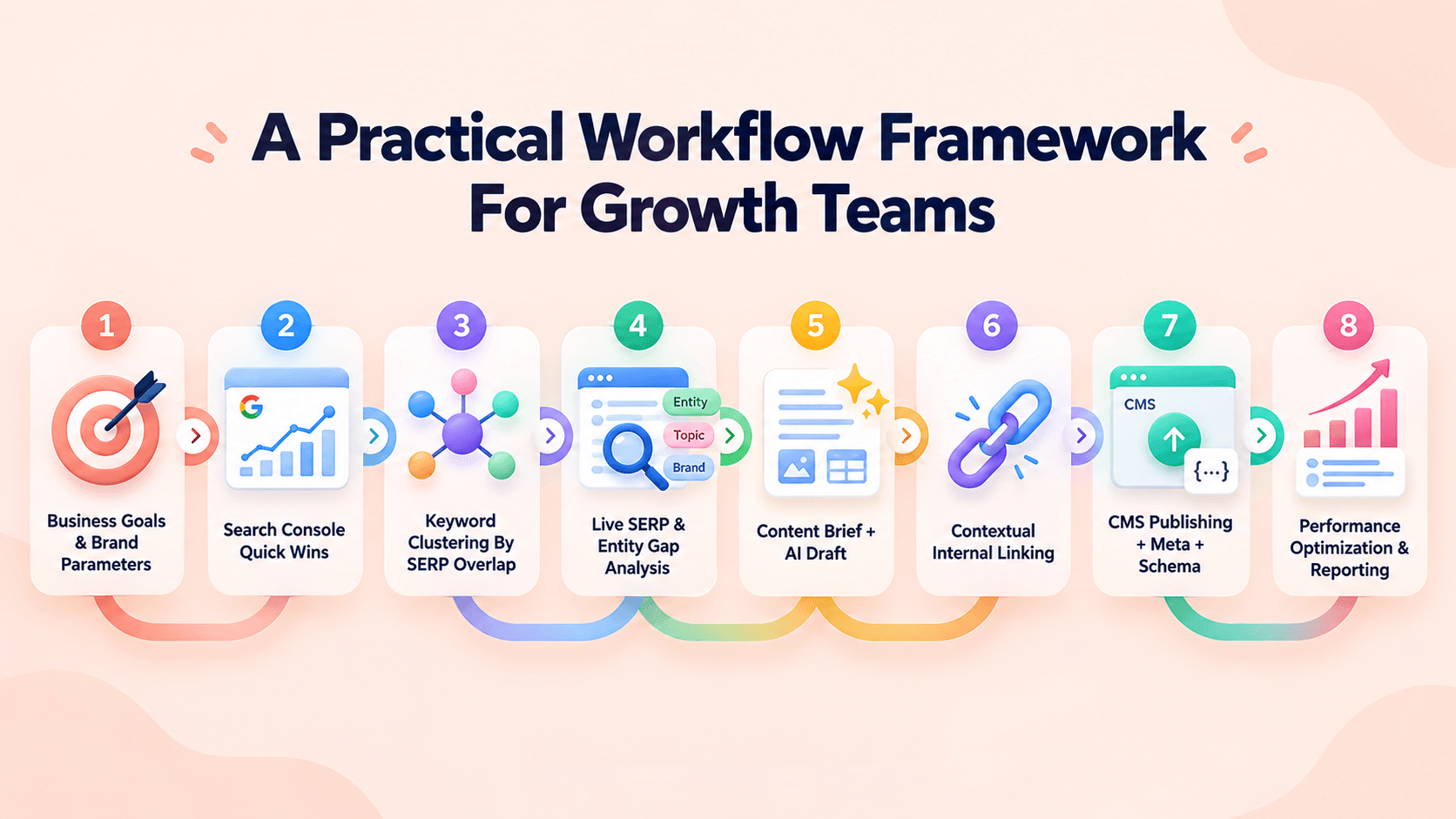
Pre-Generation Strategy Setup
The strategist sets business goals, core topics, and brand parameters. The system then pulls Search Console data, flags quick wins with high impressions and low click-through, and clusters keywords by SERP overlap.
Real-Time Drafting and Asset Generation
The system scrapes top-ranking results, reads intent patterns, and builds an outline around missing entity gaps. Drafts embed structured media, comparison tables, and direct-answer blocks built for AI citation.
Automated Publishing and Performance Optimization
The platform crawls your live URL index, matches contextual anchor opportunities, and weaves links into the draft. HTML or Markdown, meta tags, and JSON-LD schema then push to your CMS through its REST API. Add technical guardrails here. Publishing without enforced character limits, header structures, and schema validation leads to indexing failures.
The payoff is concrete. A single marketer at a Series A SaaS company needed 15 integration pages and blog posts a month. At 8 hours per post, output capped at 3 to 4 articles. With an execution engine handling research, drafting, linking, and Webflow publishing, the marketer spends 20 minutes reviewing each post and ships 15 a month.
An agency running 10 B2B accounts gets the same shift. Instead of spending Fridays pulling position data into slide decks and pasting articles into client CMS instances, reports dispatch to client Slack channels automatically. Drafts publish to staging with verified schema and internal links, and the saved hours go to strategy and retention.
Stop managing SEO across disconnected tools and workflow patches. Try SEOSorted and build your first research-backed content plan.
Common questions
Rule-based, data-intensive, programmatic tasks can be fully automated today. These include technical crawling, rank tracking, live SERP scraping, keyword clustering by URL overlap, JSON-LD schema generation, contextual internal link mapping, and direct CMS publishing through REST APIs, all without a person touching each step.
Brand positioning, strategic value proposition framing, unique narrative development, and editorial fact-checking should never run completely unassisted. Automated platforms handle research and drafting efficiently, but human oversight guarantees brand voice alignment, adds proprietary insights, and keeps conversion messaging accurate before anything goes live.
Automated tools built on live SERP extraction optimize content for AI search engines directly. By generating structured data, comparison tables, direct-answer summary blocks, and verified citations, they help your content get indexed and cited across Perplexity, ChatGPT, and Google AI Overviews.
No. Search engines evaluate content on helpfulness, factual accuracy, and user alignment, not on how it was produced. Low-quality bulk AI content that ignores search intent performs poorly. Workflows with live search context, structured data, and human editorial validation fit quality guidelines.
Advisory software analyzes search data and alerts teams to errors or keyword ideas, leaving all execution to human labor. Closed-loop automation completes the cycle: scraping live SERPs, writing brand-aligned copy, inserting contextual internal links, generating schema, and deploying directly to your CMS.
Related Reading

LSI Keyword Generator Myth vs. Modern Semantic SEO
A debunk-and-deliver guide to the LSI keyword generator myth: why Google doesn't use Latent Semantic Indexing, how legacy term checklists hurt AI Overview visibility, and how live SERP entity mapping replaces them from research through CMS publishing.

How to Rank in ChatGPT Search: 7 Levers That Drive AI Citations
A technical-depth breakdown of how to rank in ChatGPT Search across seven levers, robots.txt crawler controls, Bing indexation, answer-first content architecture, off-site entity consensus, structured schema, proprietary data, and AI visibility measurement for teams who already know traditional SEO and need the generative-search layer.

6 Best Jasper AI Alternatives for SEO Content
A bottom-funnel comparison of six Jasper AI alternatives for SEO-first content teams evaluated on post-draft execution (live SERP grounding, GEO formatting, automated internal linking, direct CMS publishing) rather than drafting speed alone.