What Is AI SEO? The Operational Blueprint for Growth Teams
A senior-level breakdown of what AI SEO actually is beyond prompt engineering: the four-phase execution architecture (keyword clustering, live SERP grounding, schema structuring, automated internal linking) that replaces fragmented tool stacks for SaaS founders, marketers, and agencies.
Published
September 25, 2026
Author
Kushi
Read time
7 mins

Your rank tracker shows a first-page position for your highest-value informational query, yet Google Analytics reports a 35% drop in organic sessions. That traffic didn't vanish to a competitor a Google AI Overview answered the searcher's question before they ever reached your blue link. Understanding what is AI SEO means rethinking optimization from manual page creation to automated answer-engine capture.
Google AI Overviews now appear on over 20% of US search queries, cutting position #1 organic click-through rates by an average of 34.5%. Meanwhile, most teams "doing AI SEO" are just running ChatGPT prompts through a browser tab, then manually copying the output into Webflow. That isn't a strategy it's the same manual workflow with an extra step.
This piece skips the "AI is changing marketing" preamble. You already know crawl budgets, on-page keyword placement, and standard analytics metrics. What follows is the operational architecture: why point-solution tool stacks quietly bleed 30+ hours a month, and the four-phase pipeline that replaces them.
The Strategic Landscape: How AI Transformed Search Mechanics
Track 1: Workflow automation across the search content lifecycle. The common industry narrative says AI SEO means mastering clever prompts. That misses the actual bottleneck generating raw text is trivial. The hard part is the workflow: keyword research, real-time SERP parsing, entity optimization, internal link insertion, and CMS deployment, all currently handled as separate manual handoffs.
Track 2: Generative Engine Optimization (GEO) and AI answer search. Optimizing only for traditional blue-link clicks now ignores a structural shift in how people search. With AI Overviews absorbing over a third of top-position clicks, content has to be engineered to earn direct citation inside AI answer summaries, not just a ranking position.
Here's the part most guides skip: purely human-written content has no built-in algorithmic advantage over grounded AI content. Ahrefs' study of over 900,000 web pages found no correlation between the percentage of AI content in an article and its organic ranking. Search engines reward topical coverage and intent alignment, not who typed the first draft.
Why Generic AI Tools and Point-Solution Stacks Fail
The model hallucination problem. Standard large language models draft from static training data with no live web access. Ask one to write about your category, and it starts inventing statistics, misdescribing competitor features, or citing outdated numbers by the third paragraph because it has no way to check what's actually true right now.
The tool stack trap. A typical setup a keyword tool, an NLP scoring editor, and a text generator sounds efficient until you count the hours. Teams report paying $150-plus a month across separate subscriptions while still spending 35 hours a month manually copying text, fixing formatting, and inserting links by hand. The subscriptions aren't the cost. The labor bridging them is.
That labor shows up everywhere: exporting CSVs from a keyword tool, pasting drafts into a scoring editor, building link lists by hand, then reformatting the HTML inside Webflow or WordPress. One comparison of the two approaches puts total labor per article at roughly 11 hours for a disconnected stack versus 15-20 minutes when research, drafting, linking, and publishing run through a single execution engine. SEOSorted's AI blog writer grounds every draft in that day's live SERP data instead of a static model's training weights, which is what actually closes the hallucination gap.
Scaling text output without fixing this creates a second failure mode: publish 20 articles and half of them sit as orphan pages, because nobody has time to manually audit a 300-page archive for internal linking opportunities. Volume without architecture just produces more pages that don't rank.
The competitive landscape breaks into three camps, and none of them close the full gap. Legacy database suites like Semrush and Ahrefs offer strong keyword and backlink data but treat AI as an optional add-on with zero autonomous publishing capability. Single-task NLP editors like Surfer SEO and Clearscope score how well a draft matches term frequency in a text box, but leave the drafting, linking, and publishing labor entirely on you. Low-cost programmatic auto-bloggers solve for raw text volume, generating from static model weights with no live SERP check, which is exactly how outdated statistics and incorrect product claims end up published.
The 4-Phase Architecture of Modern AI SEO Execution
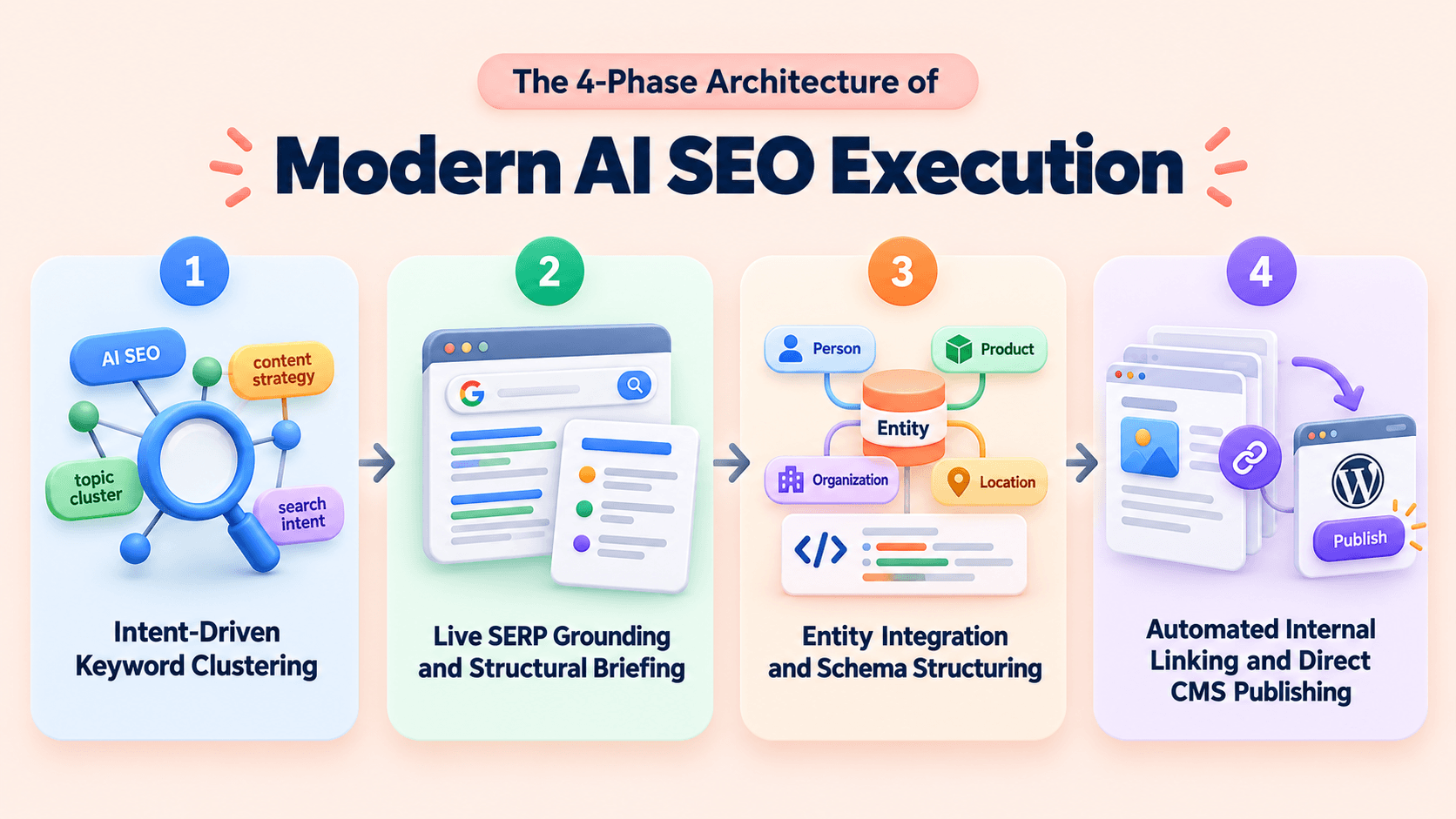 Phase 1: Intent-driven keyword clustering. Group queries by SERP overlap instead of targeting each one in isolation. Skip this and you end up writing separate 1,500-word posts for "ai seo tools" and "ai tools for seo," nearly identical queries that end up competing against each other in the index. A keyword research tool that clusters by actual ranking overlap, not just keyword similarity, prevents that from the start.
Phase 2: Live SERP grounding and structural briefing. At the moment of drafting, the system should scrape the top 10 results for the target query, extracting heading structures, core entities, and commonly cited questions. Relying on a static AI generator instead means hallucinated statistics and generic text that fails intent checks on arrival.
Phase 3: Entity integration and schema structuring. The draft needs direct-answer formatting: key entities and answer blocks placed immediately under the relevant subheading, with Article and FAQ schema auto-generated so machine crawlers and answer engines can parse it without friction. Long, fluff-heavy intros before the actual answer are exactly what AI answer engines skip over when choosing what to cite.
Phase 4: Automated internal linking and direct CMS publishing. New content needs to connect to the existing site archive automatically hyperlinks pointing in from relevant existing pages and out to cornerstone content before anything goes live. Skip this step manually at scale, and you get the orphan-page problem described above. Automated internal linking that scans the published archive and inserts contextual anchors on publish is what actually keeps new pages from sitting disconnected while old ones go stale.
Stop treating this as two separate chores. SEOSorted runs the link audit and pushes the finished, formatted post straight to Webflow or WordPress in the same pass no export, no manual paste.
A single-marketer B2B SaaS team is a useful before/after here. Manually, keyword research, outline drafting, HTML cleanup, image uploads, and link-building ran roughly 30 hours a month for 4 published posts. Running the same workload through an automated pipeline SERP scraping, grounded drafting, automatic internal linking, direct Webflow deployment brought monthly output to 15 fully optimized posts with under 3 hours of manual review.
An agency managing organic strategy for 8 SaaS clients at 80 articles a month hits the same wall at a larger scale. Coordinating keyword tools, freelance writers, separate NLP scoring tools, and individual client CMS portals produces publishing delays and inconsistent quality across accounts. Centralizing live competitor scraping, brand-voice rules, automated linking, and multi-tenant CMS publishing into one execution engine cut client publishing timelines by 70% while lowering operational cost.
Evaluating AI SEO Software: What Growth Teams Should Demand
Before buying anything labeled "AI SEO," get specific about what it actually automates. Three demands separate execution engines from glorified text generators:
- Real-time SERP grounding at generation time — not a static model drafting from training weights that go stale the moment a competitor updates their page.
- Automated internal linking on publish — a system that scans your existing archive and inserts contextual anchors, not a manual audit checklist someone has to remember to run.
- Direct CMS deployment — formatted HTML, metadata, alt text, and schema pushed straight to Webflow or WordPress, not another export-then-paste step.
Judge vendors against what they automate end-to-end, not how good their sample output reads in isolation. A well-written paragraph proves nothing if getting it published still costs you an hour of manual formatting.
This also explains why traffic swings so hard after every Google Core Update for teams running on prompt-and-paste workflows. Without a systematic way to check published pages against the intent patterns actual top-ranking competitors satisfy, you're guessing at EEAT compliance instead of verifying it at the moment of creation and a core update just exposes every page where that guess was wrong.
Stop paying for a stack that only drafts text and leaves everything else to you. Try SEOSorted to run keyword clustering, grounded drafting, internal linking, and CMS publishing as one workflow instead of five separate logins.
Common questions
AI SEO is the practice of using artificial intelligence to automate keyword research, content drafting, internal linking, and CMS publishing while optimizing pages for both traditional search engines and AI answer engines. It works by connecting language models to live SERP data to produce grounded, fully optimized content at scale.
No, Google's search guidance evaluates information quality, factual accuracy, and intent satisfaction regardless of whether a human or machine wrote it. Ahrefs' study of over 900,000 pages found no correlation between AI content percentage and ranking. Low-quality, ungrounded AI text performs poorly for the same reason low-quality human text does.
Traditional SEO optimizes pages to rank in organic results and earn website clicks. Generative Engine Optimization structures content so it can be parsed, cited, and referenced directly inside AI-generated answer summaries like Google AI Overviews, ChatGPT, and Perplexity a separate visibility channel that now competes directly with the blue link.
They crawl your published page archive to build a semantic index of existing content. When a new article is generated, the platform identifies contextual anchor points, selects relevant target URLs from that archive, and injects bidirectional hyperlinks into the HTML automatically, before the page publishes.
No, point-solution stacks introduce software fragmentation, not efficiency. Teams report losing 30-plus hours a month exporting CSVs, pasting drafts into scoring editors, and manually rebuilding what a closed-loop execution engine does automatically. The subscriptions look cheap; the labor bridging them isn't.
Related Reading

12 SEO Content Writing Tips That Actually Move Rankings
A practical, no-fluff breakdown of 12 SEO content writing tips covering search-intent mapping, answer architecture, and on-page/technical execution — built for teams that already know the basics and need what actually moves rankings in Google and AI search engines.

You Don't Need a Team to Build a Startup Anymore — You Need to Start
AI has quietly removed the biggest excuse founders have used for a decade: 'I can't build this alone.' Here's what the 2026 AI-native startup journey actually looks like, stage by stage — plus a free playbook to download.

Meta One: What Instagram and Facebook's New Paid Subscription Actually Gets You
Clickable links in organic Reels, exportable analytics, and a bolder Follow button are now behind a paywall. Here's what Meta One actually includes, what it costs, and whether creators and businesses should bother.

Start building your content library in under 8 minutes.
Your competitors are publishing every week. Every week you don't is a week of organic traffic going to them.
No Credit Card Required.