How to Build High-Quality Backlinks: A Modern Guide to Link Acquisition
A modern guide to link acquisition: what actually makes a backlink valuable, common mistakes to avoid, and how competitor gap analysis with SEOSorted surfaces realistic opportunities.

Most backlink advice still treats this as a volume game: get as many links as possible, from wherever you can. That advice is outdated and, in some cases, actively risky. Two contextually relevant editorial links from real publications in your industry typically outperform a hundred generic directory or exchange links, because search engines evaluate topical relevance and trust, not just count.
Quick answer: the highest-leverage backlink work isn't manual outreach volume or automated link exchanges; it's finding where your real competitors are already earning links you're missing, and pursuing those specific, vetted opportunities.
A distinction worth making up front: a backlink is an individual hyperlink; a referring domain is the unique site hosting it. One domain can host many backlinks, so "500 backlinks" from ten sitewide footer placements is a much weaker signal than 20 backlinks from 20 genuinely different, relevant publications.
What Backlinks Actually Do
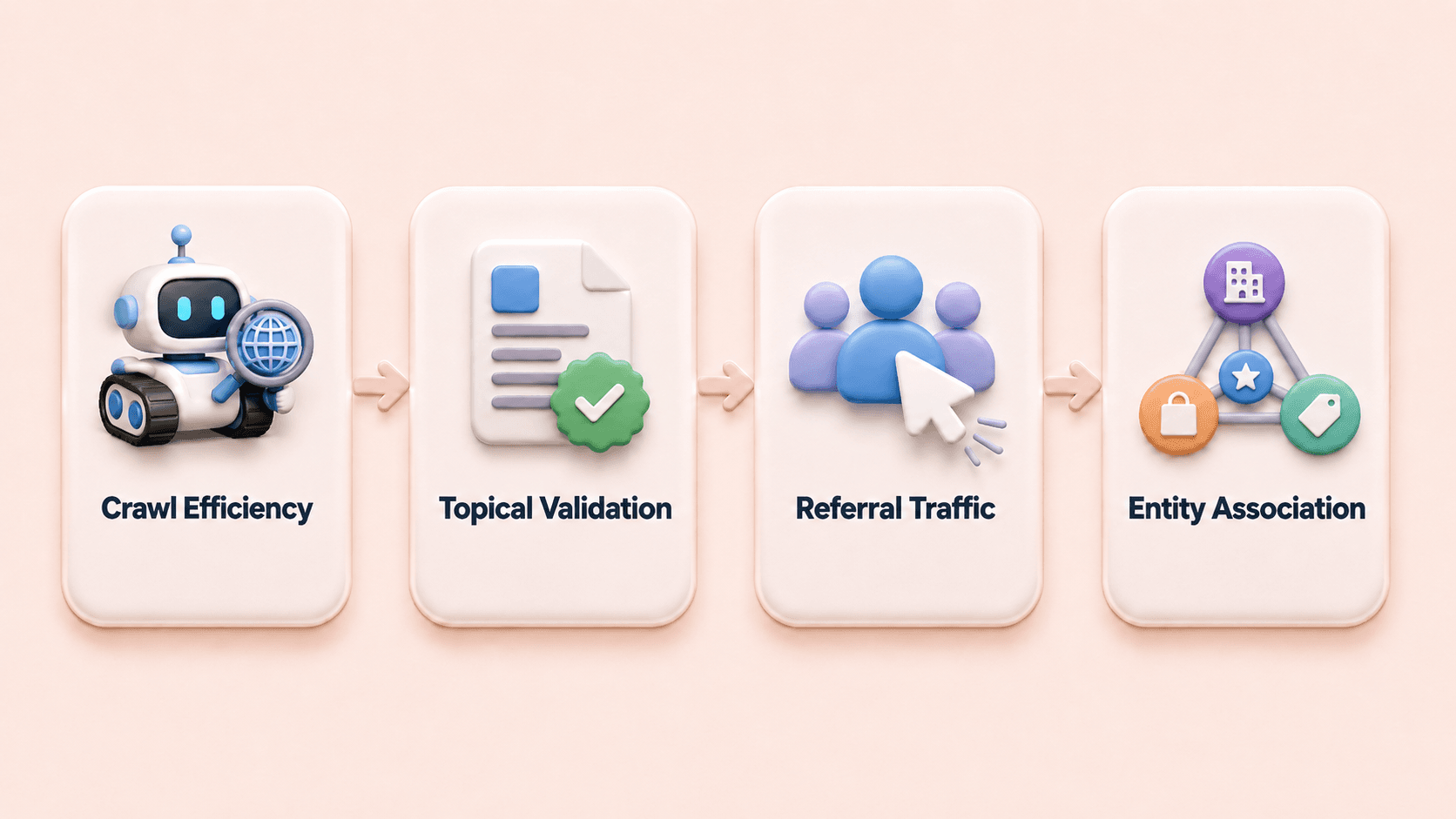 Search engines use hyperlinks to discover and crawl the web, but the value goes beyond discovery:
- Crawl efficiency — domains with diverse, authoritative link profiles tend to get crawled more frequently.
- Topical validation — a link from a relevant, established publication carries more weight than an unrelated site, regardless of raw authority score.
- Referral traffic — links in genuine guides or roundups send real visitors independent of any ranking effect.
- Entity association — in both traditional search and AI-driven answer systems, brand mentions and citations establish what category a company operates in, increasingly including unlinked mentions, not just hyperlinks.
What Makes a Backlink Actually Good
| Tier | Characteristics | Recommended Action |
|---|---|---|
| Tier 1: High-value editorial | Contextually embedded, topically relevant, real organic traffic | Actively pursue via PR, original research, outreach |
| Tier 2: Baseline/useful | Legitimate niche directories, brand profiles | Acquire during early growth; keep as part of a natural mix |
| Tier 3: Low-value noise | Low-traffic blogs, weak topical alignment | Don't actively pursue; let search engines filter naturally |
| Tier 4: Risky/scheme | Unlabeled paid links, PBNs, automated reciprocal exchange networks | Avoid entirely; audit periodically |
Worth being direct about: automated reciprocal exchange networks, even ones marketed as "AI-matched" natural link placement, are explicitly the pattern Google's link-scheme guidelines call out, regardless of how naturally the links read once embedded. And third-party metrics like Domain Authority or Domain Rating are proprietary vendor estimates, not signals Google's ranking systems use directly; chasing a high score can lead to buying links from low-quality sites built solely to inflate it. Real organic traffic to the referring domain is a more meaningful indicator.
Common Problems and Root Causes
"I've built dozens of links, but rankings haven't moved." Usually traces to topically irrelevant links, or links all pointing to the homepage instead of the page that actually needs equity.
"My competitors have thousands of links; how do I compete?" Total link count is a weak comparison point. Finding domains that link to multiple competitors but not you is a far more direct way to find realistic opportunities than trying to out-volume an established competitor.
"I'm afraid of getting penalized by cheap link packages." The fix isn't avoiding backlinks; it's vetting: real organic traffic, indexation status, and outbound link ratios before acquiring anything.
"My tool flags hundreds of 'toxic' links." In most cases, no action is needed. Search engines' automated systems generally ignore ambient low-quality spam. The disavow tool is for formal Manual Action notices, not routine toxicity-score cleanup.
A Practical Manual Workflow
- Select target pages — the category, product, or content pages that actually need equity, not just the homepage.
- Run competitor gap analysis — identify domains linking to two or more competitors but not to you.
- Vet prospects — real organic traffic, active indexation, topical relevance.
- Create something worth linking to — original research or a genuinely useful tool earns links; generic blog posts rarely do alone.
- Pitch with value, not a request.
- Monitor what you've acquired over time.
Where This Gets Hard to Do Manually
Step 2 competitor gap analysis is the highest-leverage part of this workflow, and also the hardest to do by hand. It means pulling the full backlink profile of every real competitor, cross-referencing which domains link to more than one of them, filtering out low-quality or irrelevant results, and then repeating this across every competitor you track. For a single competitor comparison, that's a spreadsheet exercise. Across three to five competitors and a real prospect list, it becomes a genuinely time-consuming research project exactly the kind of repetitive, data-heavy work that's safe to automate, as long as the final outreach decisions stay with a person.
How SEOSorted's Backlink Analysis Works
What it does:
SEOSorted's backlink analysis engine identifies where your competitors are earning links that you're missing, surfacing vetted, relevant prospects instead of a raw, unfiltered backlink dump.
How it works:
- Enter your domain and up to several competitors. SEOSorted pulls each domain's referring-domain profile.
- Gap analysis runs automatically. The system identifies domains linking to two or more of your competitors but not to you.
- Prospects are filtered by quality signals — real organic traffic, indexation status, and topical relevance — so you're not chasing low-value noise.
- Export a prioritized prospect list for outreach, with the underlying data (traffic, relevance, existing competitor links) visible for your own judgment call.
Key capabilities:
Competitor backlink gap analysis across multiple tracked competitors at once
Quality filtering based on real organic traffic and indexation, not just a proprietary authority score
Toxic and low-quality link flagging to help you decide what's actually worth a disavow (versus what search engines already ignore)
Exportable, prioritized prospect lists for your outreach team
Who it's for:
- SEO agencies running gap analysis across multiple client accounts without repeating manual research each time
- SaaS marketing teams competing against a few well-established players and looking for realistic, specific opportunities
- In-house SEO specialists who need to justify link-building priorities with real competitor data
- Consultants who want to speed up prospecting without sacrificing the vetting step
What it deliberately doesn't do:
SEOSorted's backlink feature won't enroll you in an automated reciprocal exchange network or place your links across a partner site pool. That model, regardless of how it's marketed, falls under the exact link-scheme pattern described above. The feature is built for research and prospecting, with real outreach and editorial placement staying in human hands.
Example Workflow
A SaaS company wants to compete with three established competitors in its category. Instead of manually reviewing hundreds of referring domains one at a time, the team enters all three competitors into SEOSorted. The tool surfaces a list of domains linking to at least two of them but not the company, filtered down to those with real traffic and topical relevance. The team reviews the prioritized list, drops a handful of borderline results, and builds a targeted outreach plan around the remaining prospects. This is illustrative of the workflow: actual link acquisition still depends on genuine outreach and whether you have something worth linking to.
Quick Takeaways
Prioritize relevance and topical fit over raw link volume. Use competitor gap analysis, not total link count, to benchmark realistic opportunities. Treat DA/DR as rough proxies, not real Google ranking signals. Avoid automated reciprocal exchange networks entirely; the pattern itself is the risk, regardless of the marketing. Keep human judgment in the outreach and placement decisions, even when research is automated.
Common questions
There's no fixed number. A few genuinely relevant, high-authority editorial links can outrank dozens of generic ones.
Occasional, natural reciprocal links between genuinely related sites are fine. Automated, scaled exchange networks are a manipulative link scheme under Google's guidelines, regardless of how they're marketed.
It surfaces vetted prospects through competitor gap analysis for your own outreach; it doesn't enroll you in an automated reciprocal link-placement network.
Usually not. Search engines generally automatically ignore ambient spam. Reserve disavowal for a formal Manual Action or a clear, intentional scheme you can't remove at the source.
Competitor gap analysis finding domains that link to several of your competitors but not you tends to surface more realistic, relevant opportunities than broad outreach or directory submission alone.
Other Features

How to Rank on ChatGPT: A Practical Guide to ChatGPT Search Visibility
A practical guide to ChatGPT Search visibility: what's confirmed, what's inference, and an 8-step framework to earn citations, not chase a fake #1 rank.

How to Rank on Claude: A Practical Guide to Claude Search Visibility
A practical guide to Claude's web-retrieval behavior: what's documented, what's inference, and an 8-step framework to earn citations, not chase a fake rank.

How to Appear on Gemini: A Practical Guide to AI Search Visibility
A practical guide to Gemini's web-retrieval behavior, distinct from Google AI Overviews, with a framework to track citation visibility over time.

Start building your content library in under 8 minutes.
Your competitors are publishing every week. Every week you don't is a week of organic traffic going to them.
No Credit Card Required.