How to Appear on Gemini: A Practical Guide to AI Search Visibility
A practical guide to Gemini's web-retrieval behavior, distinct from Google AI Overviews, with a framework to track citation visibility over time.

Ranking #1 on Google doesn't guarantee the Gemini app will cite you when it answers a related question. That's worth separating clearly from a related but different topic: Google Search's AI Overviews and AI Mode features, which sit inside Search itself. This guide is specifically about Gemini, the standalone assistant/app and its own web-retrieval behavior, not about AI Overviews, which deserves its own treatment given real architectural differences between the two.
A distinction worth making up front: Gemini can access the web through its own retrieval process when a query needs current information; this is different from what the underlying model may already "know" from training. This guide focuses on visibility within that retrieval-and-citation behavior.
Google hasn't published a complete technical specification of how Gemini selects and weighs web sources. What follows combines Google's published documentation, one peer-reviewed research paper on generative-engine visibility broadly, and industry observation, labeled accordingly, not presented as a guaranteed formula.
How Gemini's Web Retrieval Works
When a prompt requires current information, Gemini can query web sources, retrieve relevant pages, and synthesize a response that may include citations. Google hasn't documented every step of this process publicly, so treat any specific architectural claim, including whether Gemini draws on the same underlying index as Google Search, as something to verify against current Google documentation rather than assume.
Content that answers a question directly and factually tends to perform better in synthesized responses than narrative-heavy marketing copy. This is consistent with how retrieval systems generally behave, but it isn't an officially confirmed Gemini-specific ranking rule.
Managing Google's Crawlers
Google documents distinct crawlers and controls relevant to site owners (Google Search Central crawler documentation verifies current names and behavior against the live page before making changes):
| Crawler / Control | Documented Purpose | Effect of Blocking |
|---|---|---|
| Googlebot | Indexes pages for Google Search | Removes eligibility from Search and Search-adjacent features broadly, including AI Overviews |
| Google-Extended | A control token, not a separate crawler, governing whether content Googlebot already indexed can be used to train and ground standalone Gemini models | Opts content out of Gemini/AI training use; doesn't affect Search indexing or AI Overviews on its own |
One point worth being precise about: allowing Googlebot does not automatically extend to Google-Extended; they're independent controls that need to be configured separately, and a common mistake is assuming one directive covers both. Confirm the current, exact scope of Google-Extended directly against Google's documentation before relying on any specific claim about what it does or doesn't affect, since this control has been updated before and may be again.
What the Research Actually Shows
A KDD 2024 study by Aggarwal et al. (Princeton, Georgia Tech, IIT Delhi), "GEO: Generative Engine Optimization," tested visibility tactics across generative search engines broadly, not Gemini specifically:
| Tactic | Reported Effect (study conditions) |
|---|---|
| Adding cited statistics/data | Roughly 30-41% visibility increase |
| Attributed expert quotes | Roughly 28-41% visibility increase |
| Precise technical terminology | Roughly 18-28% visibility increase |
| Keyword stuffing/repetition | Negative effect |
The study also reported a substantially larger relative lift for lower-baseline-visibility pages than for already-dominant ones; check the original paper for the exact experimental condition before citing that figure elsewhere. None of these numbers are Gemini benchmarks; they're directional evidence from a different set of engines, and combined-tactic effects shouldn't be assumed to simply add together without direct verification.
Practical interpretations worth testing (not proven Gemini ranking factors):
- Lead with a direct answer. Open sections with a self-contained answer rather than scene-setting narrative.
- Ground claims in verifiable data. A specific, sourced figure gives a retrieval system something concrete to extract; a vague claim doesn't.
- Use structured formats where appropriate. Tables for comparisons and specs may be easier to parse than dense prose, though this isn't independently confirmed as a Gemini-specific factor.
Technical and Entity Foundations
Deploy schema Organization, Product, and FAQPage where genuinely applicable and keep it exactly consistent with visible page content; mismatches between schema and visible text can trigger quality issues in traditional search, so this is worth getting right regardless of any AI-specific effect. Schema itself isn't established as a proven Gemini citation booster.
Keep pricing, features, and descriptions consistent across your own site and any third-party listings. Inconsistent information across sources can make it harder for any retrieval system or a human reader to know which version to trust.
Gemini Visibility vs. Traditional SEO
| Dimension | Traditional SEO | Gemini Visibility |
|---|---|---|
| Goal | Rank position on a SERP | Citation presence in a synthesized answer |
| Targeting unit | Keywords | Prompt intent and query context |
| Success measure | Position #1-10 | Citation inclusion across a tracked prompt set |
| Authority signal | Backlinks, domain authority | Traditional signals plus entity consistency and broader corroboration |
Traditional SEO fundamentals: indexability, site health, content quality remain relevant prerequisites even for a different retrieval system. Backlinks may support visibility indirectly by strengthening general discoverability, but they aren't confirmed as a direct Gemini citation signal.
A Practical Framework
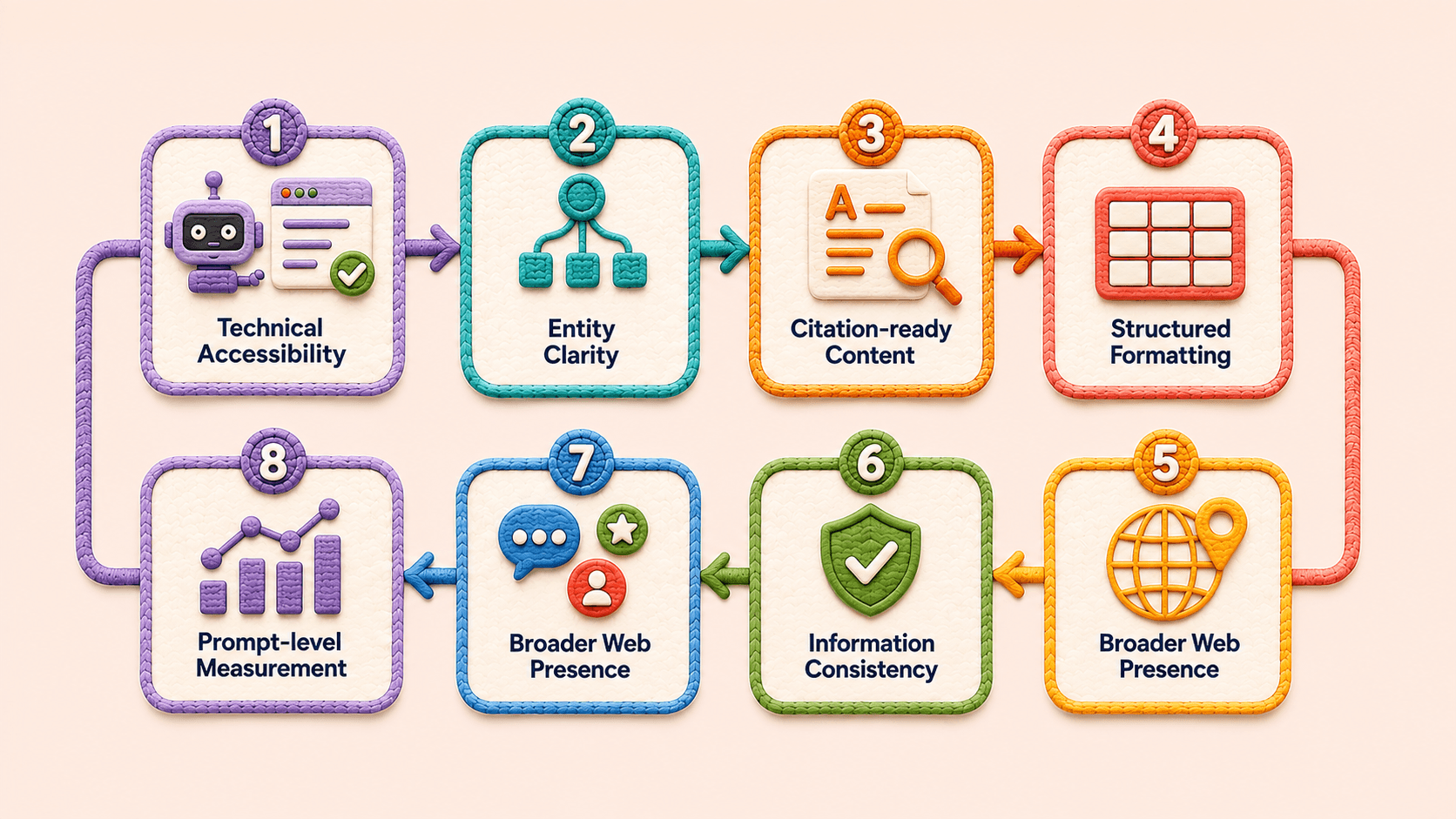
- Technical accessibility — confirm Googlebot indexes your key pages normally, and that Google-Extended is configured deliberately rather than by accident.
- Entity clarity — keep schema and cross-platform information consistent with what's visible on the page.
- Citation-ready content — rewrite key pages to open with a direct, factual answer, and support claims with specific, sourced data rather than general claims.
- Structured formatting — use tables where they genuinely clarify comparisons or specs.
- Broader web presence — maintain accurate, consistent information anywhere your brand is discussed, built through genuine activity rather than manufactured mentions.
- Prompt-level measurement — track a fixed panel of prompts over time rather than judging visibility from a single response.
Measuring Visibility
Track citation frequency instead of rank position. Build a fixed panel of 20-30 prompts across intent categories- discovery, comparison, problem-solving, commercial- and test them consistently over time, ideally monthly, in fresh sessions. Record whether your brand is mentioned, cited with a link, or recommended, along with which competitors appear alongside you and whether the cited information is accurate.
Citation Inclusion Rate = prompts where your brand is cited ÷ total tracked prompts × 100
If you're also tracking Search-side AI features (AI Overviews, AI Mode), Google Search Console's performance reports are the more appropriate tool for those; they're a separate surface from the standalone Gemini app and shouldn't be conflated when interpreting results.
Quick Audit Checklist
- Googlebot indexes your key pages without errors
- Google-Extended is configured intentionally, not by default or accident
- Top pages open with direct, factual answers
- Key claims are backed by specific, sourced data
- Schema (where applicable) matches visible content exactly
- Pricing and features are consistent across your site and third-party listings
- A fixed 20-30 prompt panel is tracked on a consistent schedule
Gemini visibility isn't about a fixed position; it's about being a clear, factually consistent, well-corroborated source for the questions people actually ask it.
Common questions
No, Gemini's retrieval process evaluates content independently, and Google hasn't confirmed that strong Search rankings translate directly into Gemini citations.
Googlebot is Google's indexing crawler for Search. Google-Extended is a separate control related to Gemini model training and grounding. Confirm the current, exact scope of each directly with Google's documentation, since definitions have been updated before.
No, this guide covers the standalone Gemini app specifically. AI Overviews and AI Mode are features within Google Search itself and involve a related but distinct retrieval architecture; treat them as a separate topic rather than assuming identical behavior.
There's no confirmed evidence that llms.txt affects Gemini citation behavior. Focus on structured, factual content that serves both human readers and retrieval systems.
Timelines vary by existing visibility, third-party presence, and content quality; there's no reliable universal figure, so track citation changes over consecutive months rather than expecting a fixed turnaround.
Other Features

How to Rank on ChatGPT: A Practical Guide to ChatGPT Search Visibility
A practical guide to ChatGPT Search visibility: what's confirmed, what's inference, and an 8-step framework to earn citations, not chase a fake #1 rank.

How to Rank on Claude: A Practical Guide to Claude Search Visibility
A practical guide to Claude's web-retrieval behavior: what's documented, what's inference, and an 8-step framework to earn citations, not chase a fake rank.

How to Appear on Perplexity: A Practical Guide to AI Search Visibility
A practical guide to Perplexity's citation behavior — what's documented, what's observed, and how to track visibility across a tracked prompt panel.

Start building your content library in under 8 minutes.
Your competitors are publishing every week. Every week you don't is a week of organic traffic going to them.
No Credit Card Required.