
Deploy 3,000 keyword-targeted comparison pages on Monday, and by Friday, discover that search algorithms have flagged the entire subfolder for scaled content abuse, suppressing organic traffic across your primary SaaS domain. That's the real risk with programmatic SEO done wrong: not that it won't work, but that it can actively damage the domain you're trying to grow.
The more common failure is quieter: growth teams ship 1,500 programmatic pages and watch Search Console flag 85% of them as "Discovered, currently not indexed," because there's no crawl equity or internal link structure actually getting search engines to the pages at all.
This breaks down when programmatic SEO is actually worth building, the search-policy thresholds that keep it safe post-2025/2026 spam updates, and the technical architecture, link equity, data enrichment, and phased rollout that separate pages that rank from pages that just sit there unindexed for months.
What Is Programmatic SEO and Why SaaS Brands Scale With It
The Head Term and Modifier Framework: Programmatic SEO pairs a repeatable head term [Tool A] vs [Tool B], [Software] for [Industry] with a modifier database, generating one templated page per combination. The volume math is what makes it worth building: instead of one article covering "best CRM software," you're capturing hundreds of long-tail variations like "best CRM software for real estate agencies" simultaneously.
Traditional SEO vs. Programmatic SEO: Traditional SEO manually builds high-effort pages targeting competitive head terms and compounds core domain authority over time. Programmatic SEO trades manual effort for structured data and templates, capturing low-competition, long-tail commercial intent at a scale no writer could match one article at a time.
Most existing coverage of this topic comes from Ahrefs, Siege Media, and agency portals connecting Airtable to Webflow via no-code tools, leaning on famous case studies like Zapier, Wise, and TripAdvisor. None of them explain how a small team without that kind of engineering headcount actually executes this safely.
Search Engine Guidelines: Navigating Scaled Content Rules
Most guides describing pSEO still date to 2022, when merging a CSV into a Webflow template was enough. That approach doesn't survive Google's 2025 and 2026 spam updates targeting scaled content abuse. SpamBrain specifically identifies near-duplicate layouts, and sustained rankings now require roughly 50-60% contextual distinctiveness per page through genuine data enrichment, not just a swapped {{city}} token.
Programmatic SEO is safe from penalties when every page delivers unique data and real user utility. It gets penalized when pages are thin, repetitive templates generated purely to manipulate rankings, the "copy one landing page fifty times and swap only the city name" pattern, which search engines now classify as doorway pages and can trigger sitewide indexation losses, not just a slap on the affected subfolder.
Updating feature matrices, pricing tiers, or location details across 800 programmatic pages by hand is its own kind of failure. That's the maintenance debt that makes teams abandon pSEO a year in, not because the pages stopped ranking, but because nobody has the bandwidth to keep 800 pages current by manual spreadsheet edits.
The Technical Architecture of High-Ranking Programmatic Pages
Here's the difference in practice between the legacy no-code stack and an automated engine handling the same five stages:
| Workflow Stage | Legacy Manual / No-Code | AI-Native Automated Engine |
|---|---|---|
| Keyword pattern discovery | Manual expansion, filtering KD<20 in spreadsheets | Automated pattern extraction pairing head terms with modifiers |
| Data sourcing | Web scraping, public dataset cleanup in Airtable | First-party metrics plus real-time SERP enrichment |
| Template engineering | Static HTML, basic {{variable}} token replacement | Dynamic content models with context-specific generation per variant |
| Internal link distribution | Manual category mapping, deep URLs left orphaned | Automatic matrix linking hubs, siblings, and product pages |
| Publishing and maintenance | CSV batch imports, manual indexation requests | Direct-to-CMS publishing with automated content refreshes |
Sourcing First-Party Data and Live SERP Enrichment: Public datasets pulled from open APIs or Kaggle without adding proprietary metrics or live SERP context create pages that mirror competitor sites; search engines index the most authoritative version and quietly ignore the duplicate. Every generated variant needs to hit roughly 60% unique content body copy relative to its sibling pages, which means real data enrichment, not a bigger spreadsheet with more rows in it.
Building Automated Hub-and-Spoke Internal Link Networks: The real barrier to programmatic growth is usually not page-generation capacity; it's link equity distribution. Deploy thousands of pages without an internal link matrix connecting parent hubs, sibling variants, and core product pages, and you'll end up with orphaned URLs that crawlers simply never reach, regardless of how good the content on them actually is.
High-Value Programmatic SEO Use Cases for Software Companies
Three patterns consistently justify a programmatic build:
- Integration directories. An automation provider capturing "Connect [Tool A] to [Tool B]" queries deployed 450 distinct integration pages using API endpoints and trigger-action data. The failure mode here is generic LLMs producing identical boilerplate across all 450 pages, which triggers exactly the thin-content demotion this whole approach is supposed to avoid.
- Comparison and alternative hubs. A mid-market CRM built 80 tailored landing pages around pricing, compliance certifications, and feature support instead of one comparison article a month covering only major competitors. Unvalidated generation tools hallucinating security features or quoting outdated pricing is the real risk here, not the page count itself.
- Localized service pages. An IT compliance firm targeting "SOC 2 Compliance Consultants in [City]" enriched each page with local regulatory requirements and regional case studies instead of copy-pasting one page fifty times. The token-swap version of this gets classified as doorway pages and risks sitewide indexation loss.
Step-by-Step Programmatic SEO Execution Framework
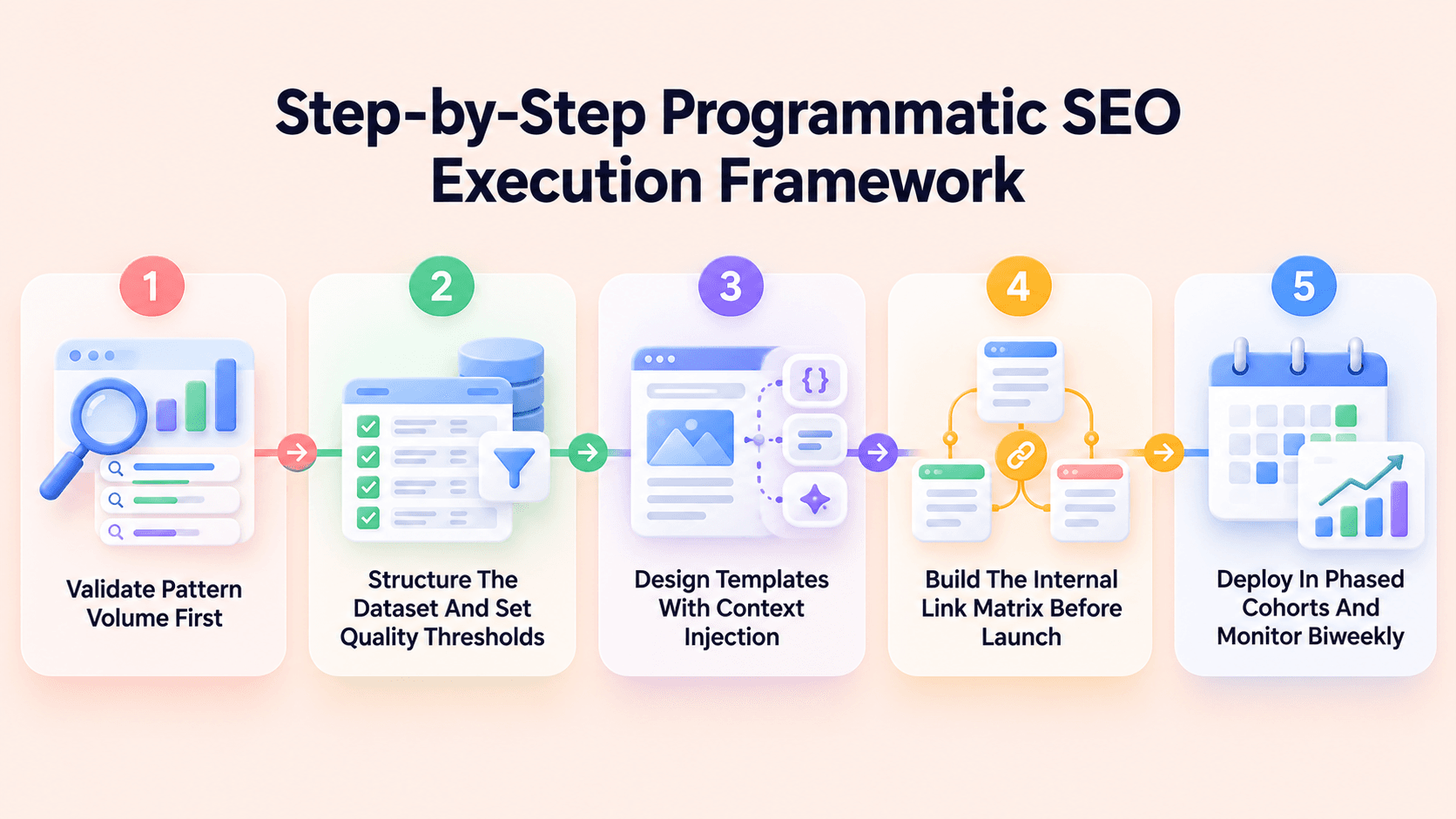
- Validate pattern volume first. Confirm the head term and modifier combination actually yields hundreds of long-tail queries with real commercial intent before building anything; a template built on thin search volume wastes engineering time regardless of execution quality.
- Structure the dataset and set quality thresholds. Assemble pricing, feature matrices, and regional data, and set the rule up front: every page variant needs at least 60% unique body copy relative to its siblings.
- Design templates with context injection, not token swapping. Combine structured data tables with dynamic headers and text sections generated from live search data, not a static block with a variable dropped in.
- Build the internal link matrix before launch. Parent hubs link to child variants, siblings cross-link to each other, and every child page passes equity back to core product pages; this has to exist before pages go live, not get retrofitted after they're already stuck unindexed.
- Deploy in phased cohorts and monitor biweekly. Publish in controlled batches aligned to your domain's actual crawl budget rather than all at once. Publishing thousands of URLs simultaneously on a domain with a modest crawl budget is what triggers the indexing delays and quality reviews in the first place. Check Search Console every two weeks to prune or enrich underperforming URLs before they drag down the cluster.
SEOSorted handles steps 3 and 4 natively. It enriches each template variant with live SERP research during generation to clear the uniqueness threshold automatically, builds the hub-and-spoke internal link network across the whole cluster without custom development, and publishes finished variants directly to your CMS, usually the exact combination that stalls a pSEO build waiting on engineering bandwidth.
Common questions
Programmatic SEO is the automated creation of search-targeted web pages using structured databases and dynamic page templates. It targets long-tail keyword combinations, software integrations, location pages, and product comparisons to capture commercial search intent across hundreds of keyword variations at once, instead of one article at a time.
Yes, when every page delivers unique data, structural distinctiveness, and genuine user utility. Search engines penalize scaled content abuse, thin, repetitive templates generated solely to manipulate rankings, not programmatic pages as a category. Incorporating dynamic search context and real internal linking is what keeps a programmatic build in compliance long-term rather than at risk of a sitewide penalty.
Traditional SEO manually builds high-effort pages targeting competitive head terms and compounds core domain authority over time. Programmatic SEO uses structured data and automated templates to publish hundreds of pages for low-competition, long-tail variations instead, capturing low-cost commercial conversions at a scale manual writing can't match.
A programmatic SEO stack typically needs keyword research tools, structured databases, dynamic page templates, and a CMS to publish through. Modern workflows add live SERP research and automated AI enrichment on top, plus direct CMS publishing integrations, which eliminate most of the manual coding and database maintenance older no-code setups required.
Near-duplicate page layouts trigger search systems like SpamBrain, which specifically detect static variable swapping, where only a token like {{city}} changes between otherwise identical pages. Sustained rankings require roughly 50-60% contextual distinctiveness per page through genuine data enrichment, not a longer list of find-and-replace values.
Related Reading

Content Cluster Strategy: A 4-Step Framework for Stalled Pillar Pages
Most stalled pillar pages are cluster design problems, not writing problems. This guide gives a four-step framework for intent mapping, pillar and spoke structure, and bidirectional linking, plus how to automate cluster upkeep.

Automated Keyword Research: How AI Replaces the Spreadsheet
Spreadsheets turn keyword research into cleanup work and cannibalization risk. This guide shows how AI clusters keywords by live SERP overlap, and gives a four-step framework for going from seed term to published draft.

What Does SEO Position Mean? A Practical Guide for Growth Teams
SEO position is the spot a page holds on a search results page, not the job title. This guide shows why average position misleads and how to track and improve rankings by intent, device, and location.