TL;DR
The best rank tracking tools do more than report keyword movement. They help you understand context, prioritize valuable opportunities, and act without creating unnecessary manual work.
Compare tools by location and device coverage, keyword organization, integrations, reporting limits, and total operating cost—not headline price or update frequency alone. For many content programs, consistent weekly tracking paired with Google Search Console is more useful than reacting to every daily fluctuation.
What rank tracking tools do—and where standalone trackers fall short

Rank tracking tools monitor where your pages appear for selected keywords over time. A tracker may check different search engines, countries, cities, devices, and SERP features, giving you a controlled view of visibility under defined conditions.
That recurring monitoring separates keyword rank tracking tools from a one-time website ranking checker. A rank checker answers, “Where does this page appear right now?” An SEO rank tracker helps you answer broader questions:
- Is visibility improving or declining?
- Which pages and topic clusters changed?
- Did a competitor gain ground?
- Are multiple pages competing for the same query?
- Did a content update produce a sustained improvement?
- Does performance differ by device or location?
This information can help you detect trends, assess content performance, monitor competitors, identify cannibalization, and communicate results. The limitation is that many standalone trackers stop at detection.
A tool may show that a page moved from position 4 to 7, but it may not tell you whether search intent changed, a competing page improved, a SERP feature displaced clicks, or your own pages began competing. Even when the issue is clear, you may still need to research the query, create a brief, revise the page, obtain approval, update your CMS, and prepare a report.
Workflow fit therefore matters as much as monitoring depth. If content growth is your goal, connect research, rank monitoring, recommendations, production, publishing, and measurement rather than treating each step as a separate task.
Rank monitoring versus rank improvement
Monitoring is data collection. Improvement requires diagnosis, prioritization, execution, and measurement.
A ranking alert has little operational value if it creates several new manual tasks. Your team may have to export affected keywords, map them to a page, inspect competitors, write an update brief, revise the article, upload it, and document the release before learning whether the change worked.
A better workflow turns a meaningful decline into a structured decision:
- Validate whether the decline is real and sustained.
- Identify the affected page, cluster, device, and location.
- Diagnose the likely cause.
- Estimate the business value of recovering visibility.
- Prepare and approve the appropriate response.
- Publish any required change through your CMS.
- Measure rankings, clicks, and conversions afterward.
Standalone rank tracking software can support the first steps. Your broader SEO process must handle the rest.
Why one ranking number is not the whole story
A universal ranking position does not exist. Device, location, language, personalization, timing, and SERP layout can all affect what a searcher sees.
A result may perform well on desktop at a national level but poorly in mobile local results within the city where your customers search. A page can also retain its traditional organic position while losing clicks because an AI Overview, featured snippet, video carousel, or shopping block occupies more of the results page.
Treat each tracked position as a controlled observation, not a definitive verdict. Consistent trends, keyword-group visibility, impressions, clicks, and conversions offer better decision support than an isolated spot check.
Best rank tracking tools by team and use case
There is no universal best keyword rank tracker. The right choice depends on the decisions you need to make, the geographic detail you require, your publishing volume, your CMS, and who must act after the data arrives.
Do not begin with a long product directory. Start with your operating model and required capabilities. If you are building a broader stack, this guide to the best SEO tools for getting work done explains why workflow coverage matters more than collecting disconnected features.
Content-led businesses and website operators
If your growth strategy depends on publishing and improving organic content, prioritize page-level intelligence over raw keyword capacity. You need to understand which page should rank, which cluster is losing visibility, and which action could improve performance.
Useful capabilities include:
- Keyword grouping by page, topic, intent, and priority
- Recommendations tied to specific content gaps
- Multiple-URL and cannibalization detection
- Update briefs based on current SERP evidence
- Approval controls for editors and subject-matter experts
- Publishing support for WordPress, Webflow, or Shopify
- Post-publication measurement and annotations
The strongest workflow reduces handoffs between identifying an opportunity and publishing an improvement. An integrated content platform can use validated ranking signals to support research, revision, approval, and CMS publishing without requiring a separate manual process for every page.
Agencies and multi-site teams
Rank tracking tools for agencies must remain manageable as projects, clients, locations, and users increase. Do not ask only whether a platform can create multiple projects. Test whether you can organize, segment, and report on those projects efficiently.
Important requirements include:
- Separate permissions and workspaces
- White-label or configurable reporting
- Scheduled reports and exports
- Annotations for releases and campaigns
- API access
- Historical data retention
- Scalable tagging and segmentation
- Clear project, keyword, and user limits
Calculate how each additional location, device, competitor, and seat affects your bill. A keyword tracked in several cities across mobile and desktop may consume more capacity than the pricing page’s keyword allowance initially suggests.
You will also need different reporting levels. Clients and executives usually need concise visibility trends and outcomes. Account teams need page-level changes, affected clusters, and diagnostic context.
In-house SEO and content teams
In-house teams usually need collaboration and prioritization more than a constant stream of alerts. Your tracker should let you tag keywords and pages by product line, funnel stage, revenue priority, owner, and editorial status.
Historical data and annotations are especially useful. Without them, connecting a visibility change to a migration, internal-linking project, content refresh, product launch, or search update becomes harder.
Separate executive reporting from operational reporting. Leadership may need organic visibility, qualified demand, and commercial outcomes. Editors need affected pages, queries, intent gaps, and recommended changes. A practical SEO KPI scorecard can help you connect ranking movement to clicks, conversions, and business impact.
Local SEO and ecommerce teams
Local rank tracking tools must reflect where and how your customers search. Look for city-level or more precise location settings, mobile monitoring, and local-pack visibility when those results influence customer acquisition.
A national desktop position may not represent your local performance. Your business can appear prominent in a broad snapshot while remaining difficult to find in mobile map results within its service area.
For an ecommerce rank tracker, prioritize:
- Category, collection, and product-page grouping
- Transactional and informational intent labels
- Shopping-result and product-result coverage
- Seasonality and promotion annotations
- Mobile visibility
- Multiple-URL detection
- Cannibalization warnings
If a category page loses transactional queries while an informational article begins ranking for them, page-level detection can expose the conflict. You can then strengthen internal links, clarify each page’s intent, or reposition the article instead of rewriting both pages indiscriminately.
How to compare rank tracking tools
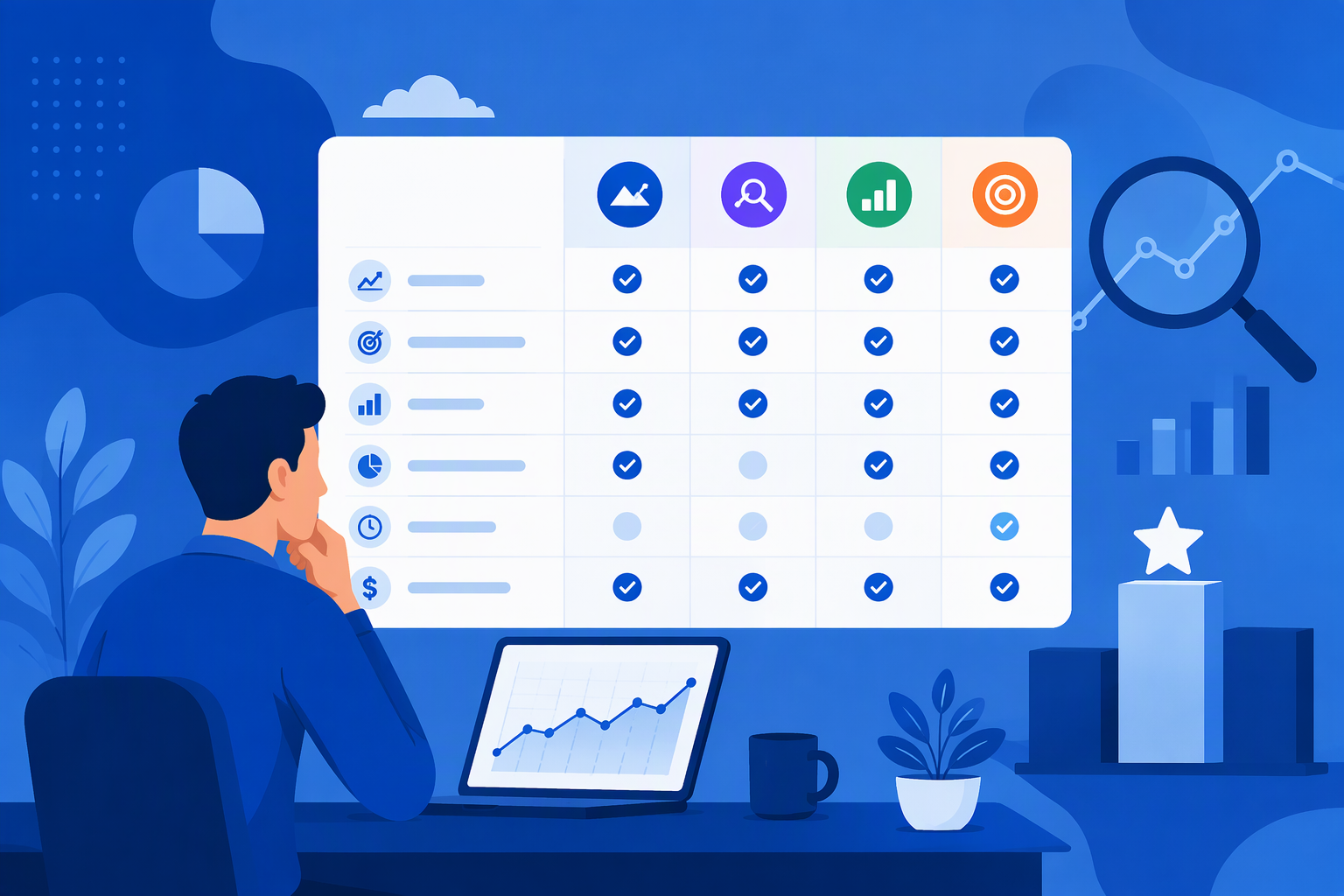
A useful comparison framework covers five areas: data scope, organization, reporting, integrations, and actionability. A feature matters only when it improves a recurring decision or removes work from your process.
Evaluate each keyword position tracker using your own pages, queries, devices, and locations during the trial. Vendor demonstrations built around clean sample projects may not reveal the limitations that appear in a live account.
Ask these core questions:
- Does the data reflect your customers’ search contexts?
- Can you organize keywords around pages and business priorities?
- Can you distinguish sustained changes from routine volatility?
- Can each stakeholder receive the right level of reporting?
- Does the tool connect to the systems where work happens?
- Can your team turn an insight into a published change efficiently?
Locations, devices, and search engines
Check whether the SERP tracker supports desktop and mobile as separate environments. Depending on your market, you may also need country, city, postal-code, or coordinate-level monitoring.
Do not pay for broad search-engine coverage merely because it looks impressive. Track Google, Bing, YouTube, or another discovery platform when it represents meaningful audience behavior.
Test how the platform counts configurations. A plan may treat the same keyword on mobile and desktop, or across different cities, as separate tracked units.
SERP features and visibility
SERP feature tracking should cover the result types relevant to your market, such as:
- Featured snippets
- AI Overviews
- Local packs
- Videos
- Shopping results
- People Also Ask
- Image results
- Knowledge panels
An unchanged organic position does not guarantee stable traffic. If a prominent SERP feature appears above your result, your page may receive fewer clicks even though the tracker reports the same organic ranking.
Look for visibility metrics that account for result type and prominence. Compare them with Search Console impressions, click-through rate, and clicks rather than assuming position alone explains performance.
Keyword grouping and page intelligence
Keyword capacity often receives too much attention. A smaller, organized keyword set can be more actionable than a large, unstructured list.
Group tracked terms by:
- Intended landing page
- Topic cluster
- Search intent
- Funnel stage
- Product or service line
- Geographic market
- Revenue or conversion priority
- Content owner
When a cluster declines, this organization helps you identify the highest-value affected page and assign a specific response instead of reacting separately to dozens of alerts.
Look for multiple-URL detection and page-level summaries. If different URLs rotate for the same query cluster, you may have cannibalization, unstable intent alignment, or weak internal signals.
Competitors, share of voice, and historical context
Competitor tracking is most useful at the market or topic level. One competitor moving above you for a single keyword may matter less than a sustained loss of visibility across a commercially important cluster.
Use share-of-voice and visibility trends to determine whether changes affect only your website or the wider SERP. If several established pages decline while a new result type appears, your response should differ from a case where one competitor improved a specific page.
Historical retention and annotations make those patterns easier to interpret. Record content updates, migrations, technical releases, campaigns, and significant search events so you can evaluate later changes in context.
Rank tracking accuracy: why tools show different positions
Rank tracking accuracy is not about finding one permanent, universal position. It is about collecting reproducible data under disclosed conditions.
One Google rank checker may use a specified city, language, device, and timestamp. Another may use a different location or check later, after the SERP has changed. Your manual search can also reflect your device, account history, location, and interface.
Legitimate differences can result from:
- Searcher location
- Desktop or mobile device
- Language and regional settings
- Personalization
- Data-center timing
- SERP experiments
- Competitor changes
- New or disappearing SERP features
An accurate rank tracker is best understood as a controlled snapshot. Consistent settings and trend analysis are more useful than comparing isolated readings collected under mismatched conditions.
A practical discrepancy example
Suppose your tracker reports position 8 for a query while Google Search Console reports a lower average position. Neither figure must be wrong.
The tracker may have captured a mobile snapshot from a defined city at a specific time. Search Console may have aggregated impressions across dates, devices, regions, users, and search appearances. Your result could have appeared in several positions across that population, producing a different average.
Use your tracker to assess movement under fixed conditions. Use Search Console to understand performance across real impressions. When a decision requires significant editorial or engineering resources, inspect both.
How to judge whether rank data is trustworthy
A trustworthy platform should disclose:
- Search engine
- Device type
- Location
- Language
- Timestamp or refresh schedule
- Update method
- Handling of SERP features
- Keyword and configuration limits
Validate consequential changes through Search Console, current SERP inspection, analytics, and conversion data. The more resources your proposed response requires, the stronger your supporting evidence should be.
Distinguish average position from controlled observations in reports. Broader SEO visibility and KPI measurement prevents one ranking snapshot from being mistaken for a complete performance assessment.
Google Search Console versus dedicated rank tracking tools
Google Search Console and dedicated trackers answer different questions. Use them as complementary sources rather than trying to declare one accurate and the other inaccurate.
Search Console provides first-party data about clicks, impressions, click-through rate, and aggregated average position. Dedicated tools produce repeatable snapshots for selected keywords, devices, locations, competitors, and schedules.
Use Search Console to understand observed performance
Use Search Console when you need to analyze:
- Clicks and impressions
- Click-through rate
- Query-to-page relationships
- Mobile and desktop performance
- Country-level trends
- Search appearances
- Broad gains and losses over time
Its average position can combine several contexts. A page may appear in different positions across users, regions, devices, dates, and result types.
Search Console is particularly useful when deciding whether a tracked decline affected actual exposure or traffic. If a tracker shows a minor drop but impressions and clicks remain stable, an immediate rewrite may not be justified.
Use a rank tracker for controlled monitoring
Use a Google rank tracker when you need a fixed keyword set checked under consistent conditions. This approach works well for priority terms, specific cities, mobile results, competitors, and SERP features.
A tracker can also maintain a scheduled history for terms that matter to your strategy, including keywords that currently produce few or no impressions. Search Console reflects observed search activity, so it does not act as a complete monitoring list for every target query.
Triangulate before taking action
When a tracked keyword declines:
- Confirm the tracker’s device, location, page, and date.
- Check Search Console impressions, clicks, click-through rate, and average position.
- Inspect the current SERP and its features.
- Review indexing and recent site changes.
- Compare competitor movement.
- Assess whether the decline is sustained.
- Estimate its traffic and conversion relevance.
A one-day decline that quickly reverses rarely deserves an emergency rewrite. Check the trend, traffic effects, SERP changes, and business value first.
Daily, weekly, or on-demand tracking
More frequent tracking is not automatically better. A daily rank tracker can produce extra cost, anxiety, and unnecessary work when your team cannot—or should not—respond every day.
Weekly tracking is often enough for stable, content-led programs. It reveals direction while filtering some routine volatility and may better match the pace at which your editorial team can research, approve, and publish improvements.
Daily or on-demand checking is more suitable for:
- Site launches
- Migrations
- Major technical changes
- High-value content releases
- Active SEO tests
- Local campaigns
- News-driven SERPs
- Highly competitive priority terms
Match monitoring frequency to decision speed. If nobody can take a justified action within a day, daily data may add little operational value.
When daily tracking is worth paying for
Daily tracking is worthwhile when a delay could hide or prolong a significant problem. After a migration, rapid monitoring may reveal unexpected page or cluster declines while recent changes are still easy to investigate.
Use thresholds to control noise. You might escalate a decline only when it lasts across several checks, affects a valuable cluster, crosses a meaningful position range, or coincides with lost impressions and clicks.
Real-time data does not replace prioritization. It only shortens the interval between observations.
How to triage a ranking drop
First, determine whether the decline is sustained and whether it affects one keyword, a page, a topic cluster, a device, or a location. Then review:
- Impressions, clicks, and click-through rate
- New or changed SERP features
- Competitor movement
- Indexing status
- Canonicals and redirects
- Internal linking
- Recent content or template edits
- Search intent changes
- Cannibalization
- Conversion relevance
Rule out technical issues before commissioning a rewrite. Use a prioritized technical SEO checklist to investigate indexing, rendering, canonicalization, internal links, and other visibility risks systematically.
Update content only when the evidence supports that response. Sometimes you should monitor, correct a technical issue, consolidate pages, or take no action.
Free versus paid rank tracking tools
Free rank tracking tools can help with occasional validation, small websites, and early-stage monitoring. A free keyword rank checker may let you inspect a limited query set before investing in a broader system.
Common restrictions include:
- Small keyword allowances
- Manual rather than scheduled checks
- Limited historical data
- Restricted locations or devices
- Few projects
- Limited exports
- No API access
- Minimal competitor tracking
- Reduced SERP feature coverage
Do not confuse a free Google rank checker with continuous performance monitoring. One check shows what appeared under one set of conditions; it does not establish a trend.
Compare paid plans by usable capacity. A low-priced plan that excludes daily refreshes, several cities, mobile monitoring, competitors, exports, or additional users may cost more in practice than a plan with a higher headline price.
Calculate total cost of ownership
Include every resource required for your workflow:
- Keywords
- Projects or websites
- Locations
- Devices
- Refresh frequency
- Competitors
- User seats
- Scheduled reports
- Exports
- API access
- Historical retention
- SERP feature tracking
Then include the labor needed to act on findings. Research, briefs, revisions, approvals, CMS uploads, annotations, and reporting all contribute to total cost.
Two similarly priced plans can create very different operating costs. That is also why a detailed SE Ranking platform review should be assessed against your configurations and workflow rather than treated as a universal verdict.
Questions to ask before starting a trial
Ask vendors:
- Does each keyword-location-device combination consume a separate allowance?
- Are daily updates included?
- Is on-demand refreshing available, and does it cost extra?
- Which SERP features are tracked?
- How many competitors can you monitor?
- Are additional users charged separately?
- How long is historical data retained?
- Are scheduled exports and API access included?
- Can you group keywords by page, intent, cluster, and priority?
- Does the platform connect insights to content updates and publishing?
- Which tasks still require separate tools or manual handoffs?
Run the trial with representative complexity. Include mobile and desktop settings, target locations, branded and non-branded terms, different page types, and a real reporting workflow.
A practical workflow from ranking drop to published improvement
An effective SEO rank tracking workflow converts data into a deliberate response. It does not treat every movement as an editorial emergency.
Integrated systems can reduce the distance between detecting a problem and publishing a solution. Keep human review focused on strategy, factual accuracy, brand quality, risk, and business priority. Automate repetitive research and production steps where appropriate.
1. Validate the signal
Compare the tracker’s change with Search Console trends and the current SERP. Confirm that you are reviewing the intended location, device, search engine, page, and time range.
Check whether the decline is isolated or visible across related terms. If only one keyword changed briefly, continue monitoring unless it is exceptionally valuable or the movement indicates a serious technical problem.
2. Diagnose the cause
Review indexing, recent technical changes, search intent, content freshness, SERP features, competitor pages, and cannibalization. Confirm whether the current page is still the right page for the query.
Your response may involve:
- Refreshing outdated sections
- Adding missing subtopics
- Improving intent alignment
- Consolidating overlapping pages
- Strengthening internal links
- Repositioning a competing article
- Correcting a technical problem
- Creating a new page
- Taking no immediate action
If an informational article begins outranking your ecommerce category page for transactional terms, inspect internal links and on-page positioning. Clarifying the pages’ roles may work better than adding more text to both.
3. Prioritize by business value
Score each opportunity using traffic potential, conversion relevance, current position, decline duration, confidence in the diagnosis, and expected effort.
This stops recent but insignificant fluctuations from consuming editorial capacity. A modest decline on a high-converting category cluster may deserve attention before a sharper drop on a low-value informational query.
Page, cluster, funnel-stage, and revenue tags help you evaluate the affected business asset instead of reacting to each query independently.
4. Create, approve, and publish the update
Build a research-backed brief tied to the diagnosed gap. Specify what needs to change, why it should change, what should remain intact, and how you will measure success.
After human review, publish through your CMS. SeoSorted’s AI SEO content workflow can help reduce the manual research, writing, and publishing work between identifying an opportunity and releasing an approved update.
Annotate the publication date. Measure rankings alongside impressions, clicks, click-through rate, qualified visits, and conversions over a meaningful period instead of judging success by the next day’s position.
Rank tracking buyer checklist
The best rank checker is the one that supports the decisions your team repeatedly makes. Before buying, confirm your use case, required data context, organizational model, workflow fit, and complete cost.
Define your primary use case
Agencies may prioritize reporting, permissions, and scale. Local businesses need precise geographic and mobile monitoring. Ecommerce teams need page grouping, product-result coverage, and cannibalization detection.
If you run a content-led program, favor a workflow that connects validated ranking changes with recommendations, production, publishing, and measurement.
Set your keyword scope
Start with keywords connected to important pages, topic clusters, and business outcomes. Track enough terms to represent each priority page’s intent and visibility without filling your account with queries nobody will review.
A smaller, organized set is usually more useful than a large, unmanaged allowance.
Test data transparency
Whether a tool is free or paid, check whether it discloses location, device, search engine, freshness, and methodology. A snapshot can be useful, but it cannot replace scheduled monitoring, historical trends, page grouping, and first-party performance data.
Review privacy and integrations
Examine data-processing terms, access controls, retention policies, authentication methods, API availability, and CMS integrations. Confirm whether you can limit permissions by project or client.
Apply requirements proportionally. An agency managing many client accounts will usually need more granular controls than a single-site team.
FAQ
Can rank tracking tools improve rankings directly?
No. Rank tracking tools collect and organize evidence; monitoring alone does not improve a page. Rankings may improve when you use that evidence to resolve technical problems, align content with intent, strengthen internal links, consolidate competing pages, or publish a better answer.
Should you track every keyword your website ranks for?
No. Track a representative priority set tied to important pages, clusters, audiences, and commercial outcomes. Search Console can help you explore your broader query universe, while your tracker maintains controlled monitoring for terms that influence decisions.
Is daily rank tracking necessary?
Not for every program. Weekly tracking may be adequate for stable content operations. Daily monitoring is better suited to migrations, launches, tests, local campaigns, volatile SERPs, and commercially critical terms. Choose a frequency that matches how quickly you can make a justified decision.
How long should you wait before responding to a decline?
Wait long enough to distinguish a sustained trend from normal volatility unless the decline follows a migration, indexing failure, or another urgent event. Compare several observations with impressions, clicks, SERP changes, and business impact. Investigating quickly does not mean you must rewrite the page.
Which metrics should accompany keyword positions?
Use impressions, clicks, click-through rate, conversions, landing-page visibility, and topic-level share of voice. Add SERP feature presence, device and location splits, and competitor movement where relevant. Together, these metrics show whether a position change affected discovery or business outcomes.
Turn rank tracking data into published improvements
Choose rank tracking tools that provide the right context, support clear priorities, and fit your publishing process. If manual research, writing, CMS uploads, and follow-up measurement are slowing your response, use seosorted.ai to turn validated SEO opportunities into approved, published improvements.
Related reading
- Glossary: Rank Tracking
- Glossary: Impressions
- Glossary: SERP Features
FREE BACKLINK PLAN
Build authority with backlinks that matter
Get a shortlist of sites that already link to competitors in your niche, ranked by authority, without doing the outreach research yourself.
- 20 link opportunities matched to your niche
- Discover competitor backlink sources
- Get actionable link-building opportunities

We'll email you the results and occasional SEO tips. Unsubscribe anytime.
Common questions
The core research-and-write loop is similar - both start from real SERP data and match your brand voice. The practical difference shows up in volume and what happens after publishing: seosorted includes 30 articles a month at the $99 price point with add-on tiers if you need more, and it feeds Search Console performance data back in to improve future articles. Outrank currently has a live backlink exchange; seosorted's is on the roadmap.
Typically 3–6 months before articles start climbing Google significantly — that's the nature of SEO, not something specific to seosorted. The compounding effect is the point: publishing consistently from day one means you're months ahead of starting later. Sites that publish 8–12 articles in the first 60 days consistently see their first rankings within 90 days. Every week without content is a week of organic traffic going to a competitor who is publishing.
Yes, always. Every article lands in a READY state first — you can read it, edit it, approve it, or reject it before anything goes live. If you'd rather not touch it, you can turn on auto-publish and articles go straight to your CMS on your chosen schedule. Full control or full autopilot — your call per article.
WordPress, Webflow, and Shopify natively — the article, featured image, meta description, and schema markup all land in your CMS automatically. For everything else — Ghost, Sanity, Strapi, Notion, or any custom headless setup — we publish via Webhook. We POST a JSON payload with the full article, SEO fields, images, and schema. If your CMS accepts a POST request, we can publish to it.
Related Blogs

SEO vs SEM: How to Choose SEO, PPC, or Both
Compare SEO and SEM by cost, speed, intent, feasibility, and ROI to choose organic search, PPC, or a balanced mix. Find the right approach today.
Updated on
Nov 12, 2026